
- NRO, NGA and Space Force clashed over acquisition authorities and responsibilities
- The agencies signed agreements clarifying roles to resolve the conflict
- NRO and Space Force leaders will deliver keynotes at the 2026 Intel Summit on Sept. 24
Commercial intelligence, surveillance and reconnaissance have become critical in the nation’s ability to monitor for threats and bolster national security. Agencies are increasingly tapping the commercial sector to supplement traditional government-owned satellite systems, filling coverage gaps and delivering data that support warfighters and decision-makers.
The growing role of commercial ISR in defense and intelligence operations once strained the working relationship between the National Reconnaissance Office, the National Geospatial-Intelligence Agency and the U.S. Space Force.

Discover opportunities for industry to provide commercial intelligence data to the National Reconnaissance Office and the U.S. Space Force at the 2026 Intel Summit on Sept. 24. Ryan Lewis, chief architect of NRO’s Signals Intelligence Directorate, and Maj. Gen. Brian Sidari, deputy chief of space operations for intelligence at the Space Force, will deliver keynote speeches at the event. Lewis oversees the definition, evaluation and integration of next-gen SIGINT at NRO, while Sidari is responsible for policy and oversight of USSF’s ISR capabilities. Secure your tickets today!
Why Did NRO, NGA & Space Force Clash Over Commercial ISR Data?
At the center of the conflict were disagreements over acquisition authorities and unclear boundaries on responsibilities among the agencies.
NRO is designated as the primary acquirer of intelligence, surveillance and reconnaissance imagery for the intelligence community and the Department of War, while the NGA oversees the purchase of analytic products and the distribution of ISR to federal government users and allies.
The creation of the Space Force in 2019 introduced tensions as the Pentagon mulled over how broad the new service’s buying power should be, which created the risk of duplicating work already assigned to NGA and NRO.
TacSRT
The friction escalated when the Space Force announced the Tactical Surveillance, Reconnaissance and Tracking, or TacSRT, program in 2024 to serve as a marketplace for buying critical data from commercial firms. The program connects field components to the commercial vendors that could immediately address specific requirements.
TacSRT is designed to accelerate the delivery of commercial ISR and tracking data to combatant commands.
Industry executives who have participated in the pilot called the marketplace revolutionary, saying that it accelerated the acquisition and delivery of critical information, according to Defense One. For some tasks, the timeline from work statement announcement to start of mission was compressed to as little as 24 to 72 hours.
Lt. Gen. David Miller, who previously led the Space Operations Command, said that the joint force commander must be able to task and retask space-based assets and get information delivered directly to warfighters.
“Anything that introduces delay in data being provided to commanders and shooters to either defend themselves and their team or prosecute, close with and destroy the adversary, we’re just not going to support that,” he added.
Vice Adm. Frank Whitworth, former NGA director and a four-time Wash100 awardee, pushed back on assertions that the agency is slowing down data-sharing.
“My inbox would be full of emails if we were failing in this regard—and it is not. I do not get negative reports from the COCOMs on our timelines,” Whitworth stated.
Chief of Space Operations Gen. Chance Saltzman, a four-time Wash100 winner, said that the program was not meant to compete but complement the work of the IC in delivering unclassified operational planning products, DefenseScoop reported.
The service has since begun efforts to scale the program.
GMTI
Dispute also emerged over the dissemination of data collected by the Ground Moving Target Indicator, or GMTI, sensors that track objects of interest in real time.
NGA has historically been responsible for ISR satellite tasking and for deciding who gets priority access to geospatial intelligence collected from all sources, including GMTI sensors. However, the Space Force worked out an arrangement with NRO wherein the latter would oversee the operations of GMTI satellites while the space service would manage tasking on behalf of combatant commanders.
A former intelligence official disclosed that NGA felt like it was “being completely cut out of the loop.”
Hear more about programs such as the GMTI at the 2026 Intel Summit. Leaders from across the IC will be present at the event to discuss the capabilities needed to support evolving government priorities. Tickets are available here!
How Did the Agencies Resolve the Turf War?
After more than two years of negotiations, NRO, NGA and the Space Force reached a resolution through two separate agreements.
NRO & Space Force
In April 2025, Col. Richard Kniseley, head of Space Systems Command’s Commercial Space Office, shared that he had signed an unclassified version of an agreement on how USSF and NRO will share acquisition authority for, and access to, commercial remote sensing satellite imagery and data.
Kniseley revealed that the agreement will enable COMSO to work with NRO’s Commercial Systems Program Office to acquire commercial products.
“In a nutshell, it allows us, COMSO, to pass them money, and for them to pass us money. So, if we have an entity on contract and they want to do a task order, or even put some money on the Global Data Marketplace, that’s how they’re going to be able to do that,” he explained.
The Global Data Marketplace is a contractor-operated platform that the Space Force uses to purchase data and services. From January 2023 through September 2025, USSF’s Joint Commercial Operations Cell spent $76.8 million on data and services from the platform, the Government Accountability Office revealed.
NGA & Space Force
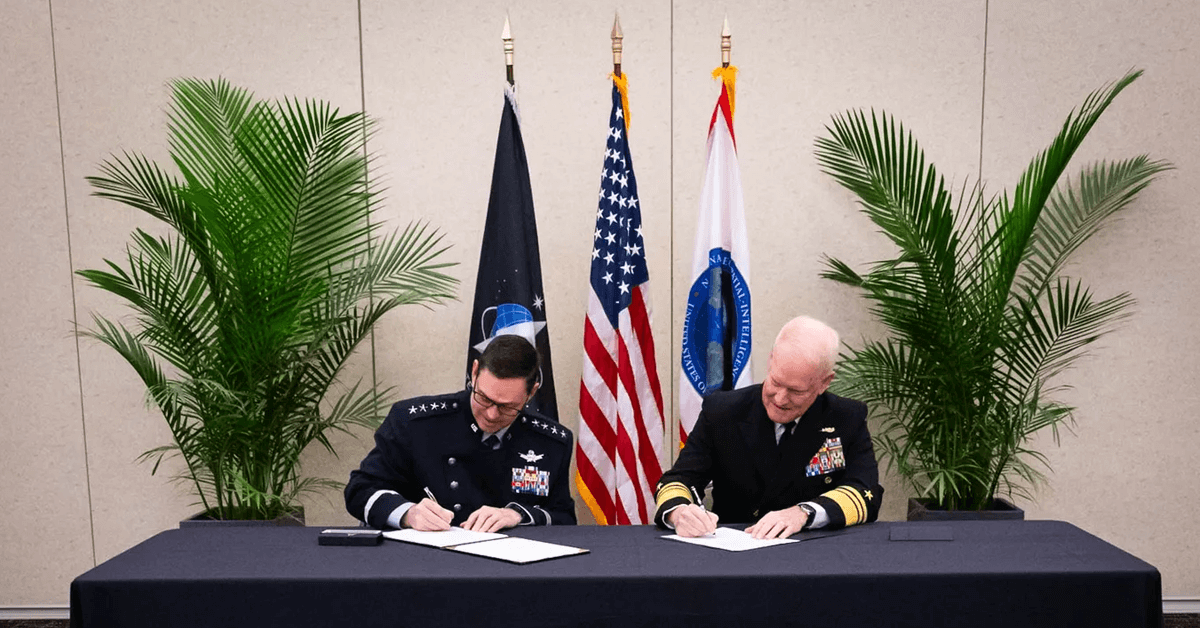
The Space Force also settled its dispute with NGA in 2025 after signing a memorandum of agreement that more clearly defined roles and responsibilities over the purchase of ISR products from commercial satellite operators. The MOA aims to reduce duplicative efforts across both organizations and enhance support for COCOMs.
Whitworth commented that the MOA ensures that the Space Force and NGA are “not going to be stepping on each other.”
What Is the Commercial Space Protection Tri-Seal Strategic Framework?
In recognition of the critical role of the commercial space sector in strengthening national security, NRO and NGA are also working with the U.S. Space Command to safeguard industry assets in orbit.
Under the Commercial Space Protection Tri-Seal Strategic Framework signed in 2023, the three organizations will share threat information and coordinate with industry to mitigate threats to commercial space capabilities.
USSPACECOM will investigate anomalies and lead threat information sharing with NRO’s commercial partners. NGA will also receive information that poses serious threats to space assets vital to intelligence collection.
Learn more about how NRO, the Space Force and other agencies are partnering with industry to strengthen the nation’s space capabilities at the 2026 Intel Summit on Sept. 24. Senior officials from the FBI, the CIA, the National Security Agency, the Department of Homeland Security, the Drug Enforcement Administration and more will share insights about modernization, global competition, the evolving threat landscape and the role of industry in advancing IC priorities. Get your tickets today!