- Navy disestablishes combined N2/N6 office, splits intelligence, enterprise IT policy and resource sponsorship into three separate organizations
- New leadership includes Steve Parode at N2, Jennifer Edgin at N6N9C and Rear Adm. Susan Bryer Joyner at N99
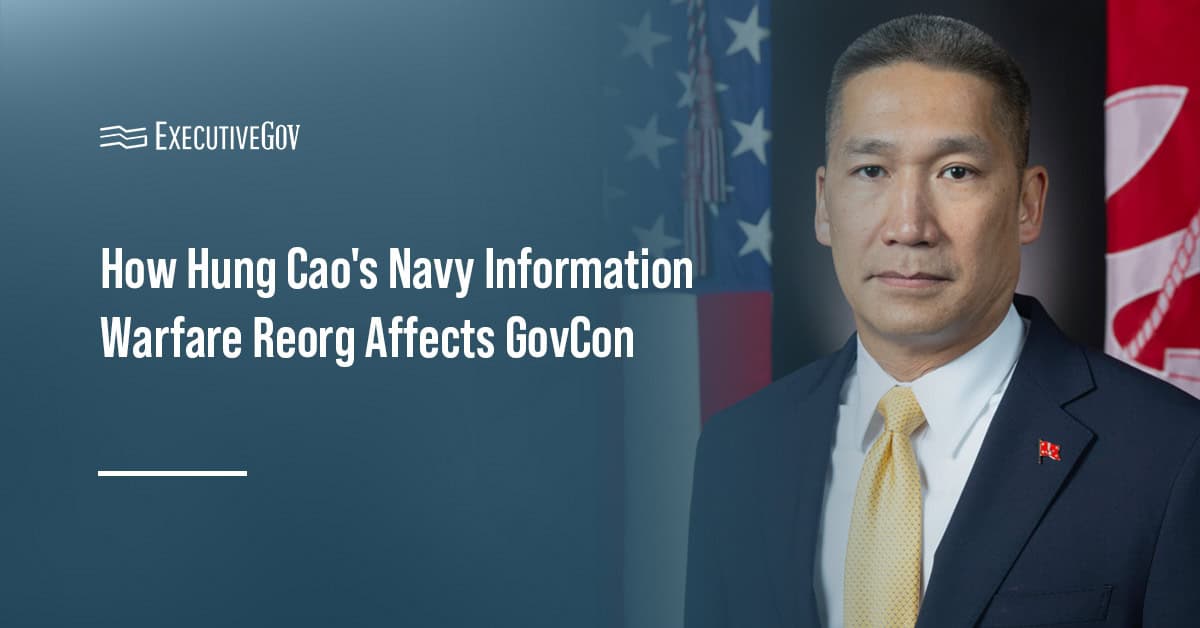
- Acting Secretary Hung Cao to deliver keynote on Navy modernization priorities at POC’s 2026 Navy Summit, Aug. 27
The Department of the Navy is quietly making one of its most significant information warfare organizational changes in years, and while it has received relatively little attention outside defense circles, the restructuring could have meaningful implications for government contractors pursuing Navy cyber, intelligence, networking and command-and-control work.
During a recent interview with retired Adm. James Foggo, Under Secretary of the Navy Hung Cao discussed the reorganization, which separates intelligence operations, enterprise technology oversight and resource sponsorship into distinct organizations. For industry, the move does not fundamentally change how contracts are awarded, but changes who defines requirements, prioritizes funding and ultimately impacts future procurements.
As the Department of the Navy restructures its approach to information warfare, acquisition and digital modernization, these topics will take center stage at the Potomac Officers Club’s 2026 Navy Summit on August 27. Acting Secretary of the Navy Hung Cao will deliver a keynote address exploring the service’s modernization priorities, while senior government and industry leaders will discuss AI, enterprise networks, Project Overmatch, autonomous systems and the future of maritime operations. Register today to hear directly from the decision-makers influencing the Navy’s next generation of capabilities.
What Was the Navy’s N2/N6 Organization?
Before the reorganization, the Office of the Chief of Naval Operations’ N2/N6 served as the Navy’s central organization for information warfare, according to DawnBreaker. The office’s former organizational description stated that the deputy chief of naval operations for information warfare and director of naval intelligence oversaw intelligence, cyber warfare, command and control, electronic warfare, tactical and enterprise networks, oceanography and meteorology while maintaining end-to-end responsibility for Navy information warfare investments, capabilities and forces.
As information warfare missions expanded, the office’s responsibilities grew to encompass operational intelligence, enterprise IT policy, capability development and resource sponsorship under a single leadership structure.
What’s Changing?
The Navy has officially disestablished the combined OPNAV N2/N6 organization and redistributed its responsibilities among three separate organizations focused on intelligence, enterprise capability oversight and resource sponsorship, according to Breaking Defense.
N2: Intelligence Operations
The new OPNAV Intelligence Division is led by Steve Parode and reports through N2N3N5N7, reported Naval Intelligence Professionals. The organization now focuses on strategic and operational intelligence, intelligence production, fleet intelligence requirements, Naval Intelligence Activity oversight and engagement with the Intelligence Community.
Rather than overseeing acquisition priorities, N2 now concentrates on intelligence integration and operational support to fleet commanders.
N6N9C: Information Warfare Requirements and Enterprise Policy
Jennifer Edgin leads the assistant deputy chief of naval operations for information warfare requirements and capabilities organization, or N6N9C.
The office serves as the principal advisor for information warfare policy, enterprise information technology, cyber, space and digital modernization while also performing Department of the Navy deputy CIO responsibilities. It is expected to oversee enterprise capability requirements and technology policy across the naval service.
N99: Information Warfare Resource Sponsor
Breaking Defense reported that Rear Adm. Susan Bryer Joyner now leads N99, the director for information warfare organization.
The office assumes responsibility for programming, budgeting and capability sponsorship for tactical intelligence, electronic warfare, cyber operations, tactical networks, positioning, navigation and timing, meteorology, oceanography and command-and-control systems through the Planning, Programming, Budgeting and Execution process.
Why Does the Reorganization Matter?
According to Breaking Defense, the restructuring separates three functions that previously existed under a single organization:
- Intelligence operations, or N2
- Enterprise requirements and policy, or N6N9C
- Resource sponsorship and PPBE programming, or N99
The publication also noted that the approach mirrors a similar restructuring undertaken by the Air Force in 2024, reflecting a broader Department of War trend toward separating operational intelligence from acquisition planning and resource sponsorship.
For contractors, that distinction matters because the offices influencing capability priorities and funding decisions are no longer the same organizations managing intelligence operations.
Which Navy Program Offices Could Feel the Biggest Impact?
The Navy has not announced changes to NAVWAR, PEO C4I, PEO Digital or contracting authorities as part of the reorganization. Instead, based on the new organizational responsibilities, the acquisition community will largely continue executing existing programs while working with different requirements sponsors and resource owners.
Analysis of the reorganization indicates the program offices most likely to experience changes in stakeholder engagement include:
- PEO C4I, including:
- PMW 120 (Battlespace Awareness and Information Operations)
- PMW 130 (Cybersecurity)
- PMW 150 (Command and Control Systems)
- PMW 160 (Tactical Networks)
- PEO Digital, particularly programs supporting the Naval Enterprise Network and Department of the Navy CIO.
- Naval Meteorology and Oceanography Command, which maintains alignment through the new N99E organization.
- Intelligence capability organizations supporting N99Q and the new N2 intelligence organization.
These organizations already manage many of the Navy’s largest information warfare acquisition portfolios, making the shift in requirements sponsorship particularly relevant for industry engagement.
For contractors pursuing Navy information warfare opportunities, understanding organizational changes is only part of the equation. The 2026 Navy Summit will bring together acquisition executives, military leaders and industry innovators on Aug. 27 to discuss how priorities across digital engineering, cyber, tactical networks, enterprise IT and maritime command and control are translating into future requirements.
Which Contract Vehicles Could Be Affected?
The available reporting does not indicate that contracting offices or acquisition organizations are being reorganized.
Instead, based on publicly available contract information, contractors should expect future solicitations that previously referenced OPNAV N2/N6 to instead identify N99, N6N9C or N2 as sponsoring organizations. Funding sponsors and approval chains may likewise shift under the new structure.
Contract vehicles that could experience changes in customer alignment include:
- SeaPort NxG task orders supporting information warfare organizations
- Remaining task orders associated with the former OPNAV N2/N6 Professional Management Support Services contract
- Tactical network support contracts supporting command, control and communications organizations
- Information operations advisory contracts
Although acquisition offices remain largely unchanged, industry teams may need to adjust engagement strategies as requirements sponsors evolve.
What Should GovCon Teams Watch?
For capture managers, the practical impact of the reorganization is less about contract administration than about understanding where future requirements originate.
Based on the Navy’s new organizational structure, N99 is expected to become the principal stakeholder for tactical information warfare modernization, capability sponsorship and PPBE decisions. N6N9C is positioned to influence enterprise IT, cybersecurity, digital transformation and CIO policy, while N2 becomes the focal point for intelligence integration and coordination with the Intelligence Community.
As a result, companies pursuing Navy information warfare opportunities may benefit from updating stakeholder maps and business development strategies to reflect the new leadership structure.
While NAVWAR, PEO C4I, PEO Digital and existing acquisition pathways remain largely intact, the officials responsible for validating requirements, setting investment priorities and influencing future procurements have shifted. For companies competing in the Navy’s information warfare market, understanding those new decision-makers may prove just as important as understanding the contract vehicles themselves.
As responsibility for intelligence, cyber, enterprise IT and information warfare evolves across the Navy, understanding who shapes requirements and funding decisions will become increasingly important for government contractors. The 2026 Navy Summit, set for Aug. 27, offers a timely opportunity to hear Acting Secretary Hung Cao and other senior defense leaders discuss the policies, technologies and acquisition priorities driving the future fleet. Register now to connect with the officials and industry executives leading the next phase of Navy modernization.