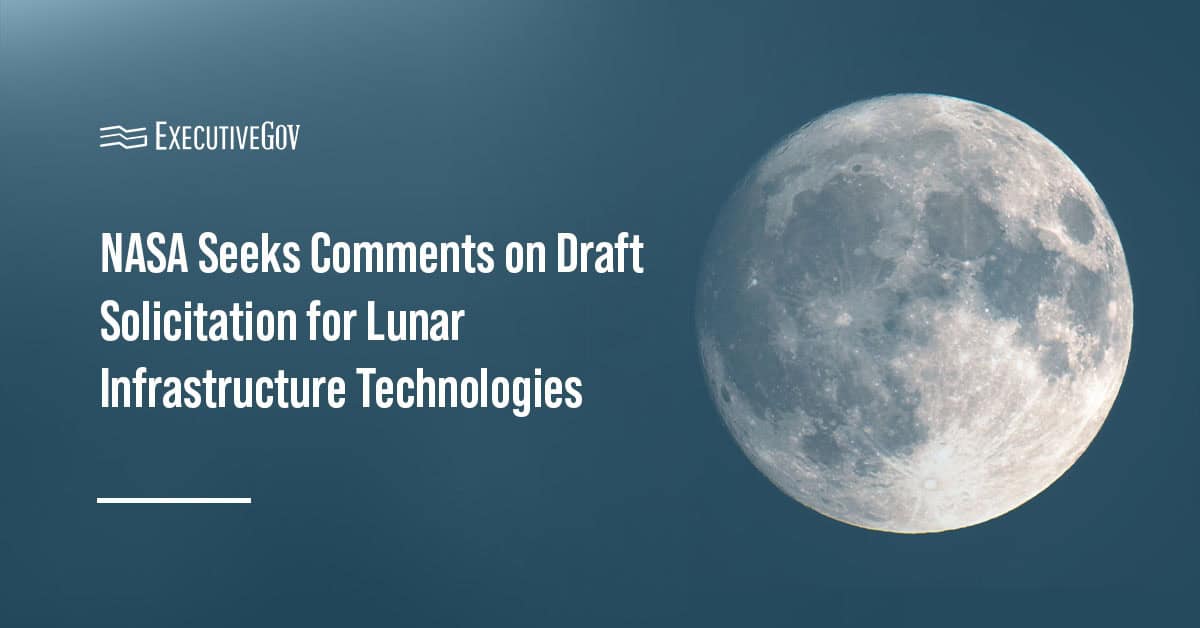
- NASA is seeking industry feedback on a draft solicitation to fund prototypes in five technology areas key to sustained lunar operations
- The Lunar Enabling Infrastructure Accelerator covers vertical solar arrays, oxygen production from lunar soil, radioisotope generators, in-space manufacturing and nanomaterials
- NASA wants awardees to build and demonstrate prototypes that push the technologies toward readiness levels 5 to 6
 NASA has asked industry to weigh in on a draft solicitation that would fund prototype development in five technology areas the agency considers essential to sustaining operations on and around the moon.
The agency released the draft Monday under its NextSTEP-3 broad agency announcement, calling the effort the Lunar Enabling Infrastructure Accelerator, or LEIA. Comments are due July 17. The agency plans to issue the final solicitation in the fourth quarter of fiscal year 2026, with awards anticipated in the first quarter of fiscal 2027.
NASA’s role in advancing the nation’s space priorities will be part of the conversation at the Potomac Officers Club’s 2026 Air and Space Summit on July 30. NASA Deputy Administrator Matt Anderson will join top Air Force and Space Force leaders and industry executives for a full day of keynotes, panels and networking on the advanced technologies needed to stay ahead in the air and space domains. Register today to secure your spot.
What Technologies Does LEIA Target?
The five topics trace to gaps NASA identified in its Civil Space Shortfalls assessment. They cover a vertical solar array for surface power, a system for producing oxygen from lunar regolith, a Stirling radioisotope generator that converts nuclear heat into electricity for operations in dark or remote environments, in-space advanced manufacturing, and the production of innovative nanomaterials.
Each topic is a separate competition, and companies may submit one proposal per topic. NASA wants awardees to design, build and demonstrate prototype systems and to produce validated performance data, analytical models and operational insights, pushing the technologies toward readiness levels 5 to 6 while cutting the risks tied to future missions. The work aims to generate the evidence NASA needs to make technical and programmatic decisions.
Greg Stover, who directs the Advanced Research and Technology Division within NASA’s Research and Technology Mission Directorate, said a lasting human presence at the moon depends on breakthrough ideas from a competitive U.S. industrial base.
How Will the LEIA Competition Run?
NASA is planning firm-fixed-price contracts with performance-based milestone payments and may award one, several or none for each topic. Contracts would run no longer than three years, structured as a base period with options, each gated by a continuation review. Awards fall under the North American Industry Classification System code 541715 with a 1,000-employee small business size standard.
Proposals cannot involve collaboration with China or Chinese-owned entities. Offerors must disclose any plans to use artificial intelligence in performing the work.