- Richard Beckman previously led AFRL’s Space Vehicles Directorate, overseeing space technology programs
- Beckman has held leadership roles across the Space Force, AFRL and Joint Staff acquisition organizations
- Corey Klopstein grew the OTTI organization into a 300-member team managing a $500 million annual budget
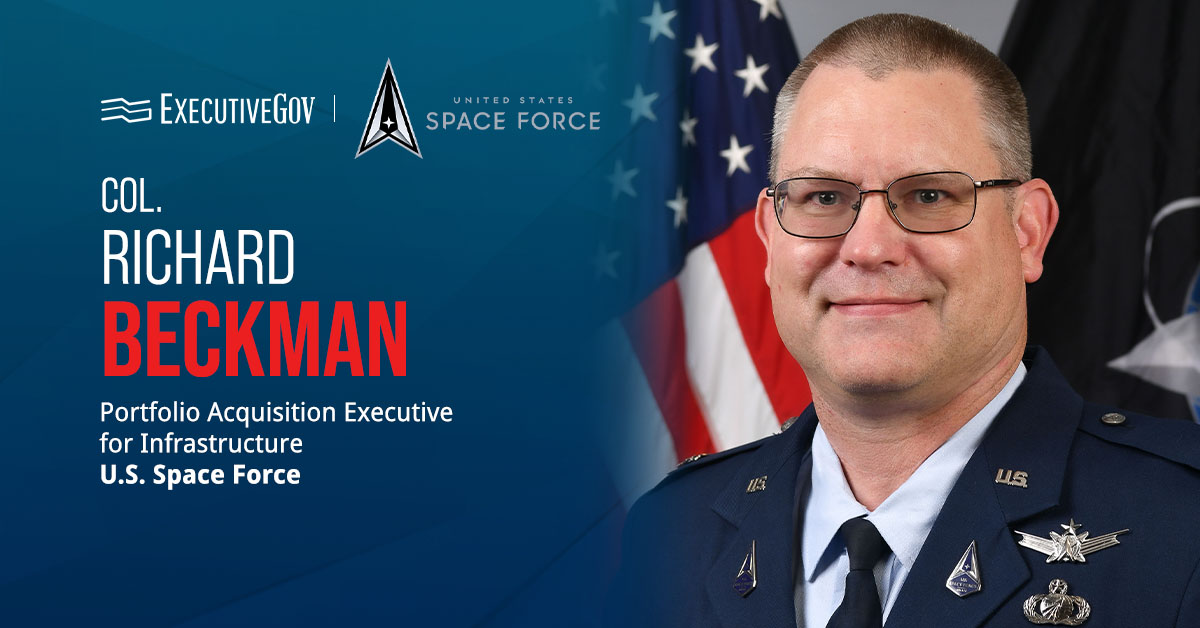
Col. Richard Beckman assumed leadership as portfolio acquisition executive for infrastructure, succeeding Col. Corey Klopstein during a ceremony held Thursday at Peterson Space Force Base in Colorado.
Who Is Richard Beckman?
Beckman is a Space Force acquisition and research and development leader with experience in space systems and advanced technology programs. Before assuming the infrastructure portfolio role, he served as commander of the Phillips Research Site and director of the Air Force Research Laboratory’s Space Vehicles Directorate, which develops technologies supporting position, navigation and timing, communications, missile warning, space control and space domain awareness missions. In that role, he led a workforce of more than 1,080 military, civilian and contractor personnel. Earlier in his AFRL career, Beckman served as senior materiel leader and chief of the Integrated Experiments and Evaluations Division within the Space Vehicles Directorate.
He was the first Guardian vice commander of the Air Force Technical Applications Center and headed the Space and Cyber Branch within the Joint Staff’s Capabilities and Acquisition Division.
What Did Klopstein Accomplish During His Tenure?
On March 18, Klopstein became the first PAE for Infrastructure, bringing the Operational Test and Training Infrastructure, or OTTI, program together with other key infrastructure efforts for the Space Force. Before assuming that role, Klopstein oversaw System Delta 81, the organization responsible for developing advanced test, training and tactics capabilities. He also led the OTTI program executive office since its October 2023 activation, during which he built the organization from a staff of fewer than 10 into a 300-member team managing a $500 million yearly budget, while the test-and-training budget under his direction expanded from $870 million to more than $2 billion.
Thomas Ainsworth, acting assistant secretary of the Air Force for space acquisition and integration, credited Klopstein with laying the foundation for the enterprise. Under Klopstein’s leadership, the Space Force secured its first combat training program of record and delivered key test and training capabilities, including an orbital range, an updated electromagnetic spectrum operations range and the service’s first cyber range.