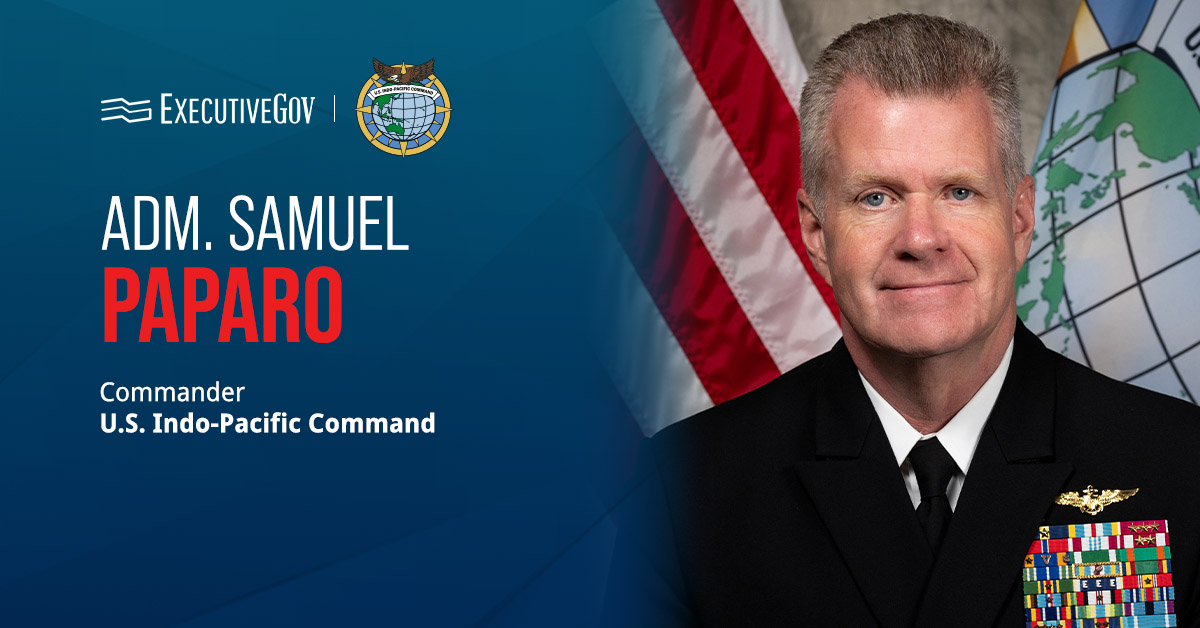
- U.S. Navy Adm. Samuel Paparo reportedly sent a private report to Congress detailing the needs of the Indo-Pacific Command to counter threats from China
- USINDOPACOM is requesting $122 billion in fiscal 2027 funding
- Paparo said that China is developing economic, legal and information warfare tactics
U.S. Navy Adm. Samuel Paparo, commander of the U.S. Indo-Pacific Command and a Wash100 winner, submitted a private report to Congress stressing the need for new military equipment to counter the growing threat of war against China, the Washington Times reported on Tuesday.
Bill Gertz writes that they obtained an independent military assessment in which Paparo justified their unit’s request for more than $122 billion in funding for fiscal 2027 to counter potential threats from China. It includes $18 billion for military control system countermeasures, $2.3 billion for drone weapons on the ground and sea, and $67.4 billion for missile systems. He said that this represents “the minimum investments required to sustain credible deterrence and prevail in conflict if deterrence fails.”
What Did Paparo Say About Indo-Pacific Security?
“The security environment in the Indo-Pacific is becoming more dangerous and defined by an increasing risk of confrontation and crisis,” Paparo stated in the assessment. He said that aside from military force, China is also gearing up for economic, legal and information warfare. He also expressed concern on the deepening ties among China, Russia and North Korea.
What Measures Are Being Taken by USINDOPACOM to Prepare for China’s Threats?
According to the report, USINDOPACOM plans to use a new air and missile defense system being constructed in Guam in the event of ballistic, cruise and hypersonic missile attacks from China. For instance, two weapons that could be launched from Guam to China are the U.S. Army’s Typhon Mid-Range Capability Tomahawk land-attack cruise missiles, and the Dark Eagle long-range hypersonic missile. Paparo also cited a long-range hypersonic missile dubbed Blackbeard, which is “designed to deliver 80% of advanced hypersonic capability at a fraction of the cost.”
Other key provisions in the budget request include $3 billion for infrastructure expansion, in Hawaii, Guam and the Pacific Islands of Palau, Tinian, Wake, and Yap, $107 million for military artificial intelligence, and $50 million for an unmanned underwater vehicle base in Japan.