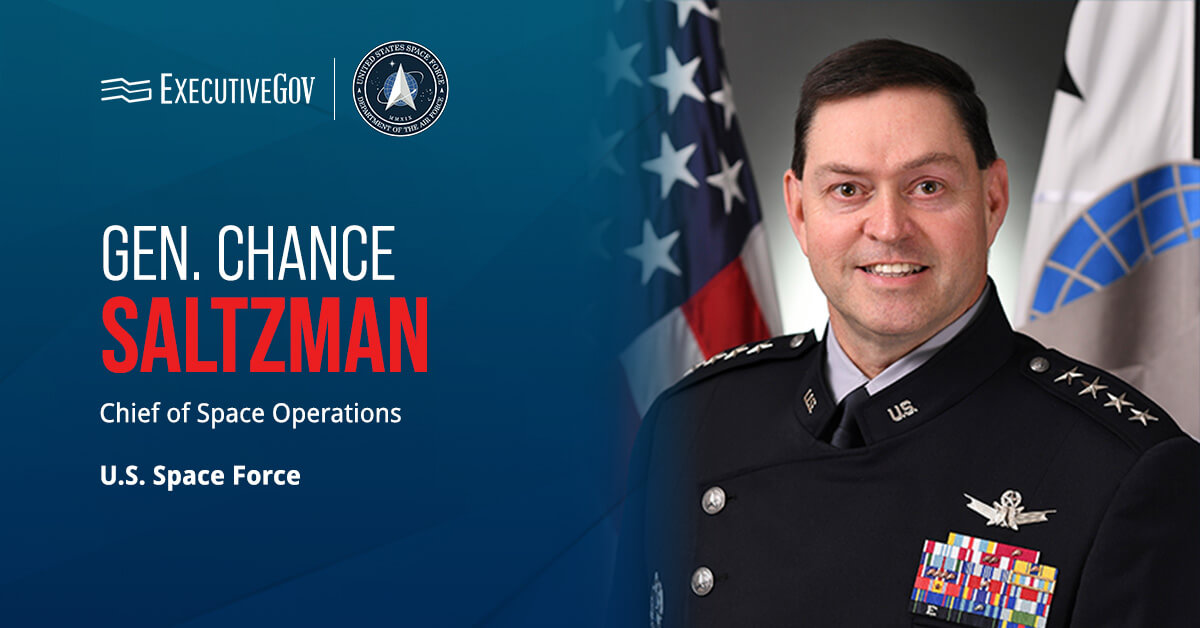
Chief of Space Operations Gen. Chance Saltzman, a four-time Wash100 Award recipient, has outlined how the U.S. Space Force plans to prepare for an increasingly contested space domain.
Speaking at the 41st Space Symposium, Saltzman introduced two foundational planning constructs — a Future Operating Environment and an Objective Force — that together define how the service intends to counter emerging threats and scale its capabilities over the next 15 years, the Space Force said Wednesday.
The effort reflects a broader strategic pivot: preparing the Space Force to operate in a domain where adversaries are rapidly closing capability gaps and where space systems are increasingly vulnerable targets.
The Potomac Officers Club’s 2026 Air and Space Summit, scheduled for July 30, will feature discussions on the strategies leaders are developing to address evolving challenges across the air and space domains. Register now!
Why Is the Space Force Reframing Its Long-Term Strategy?
Saltzman signaled that the service’s current structure is insufficient for the threat environment it expects by 2040, emphasizing that future competition in space will be defined by speed, scale and resilience.
The Future Operating Environment serves as a planning baseline rather than a forecast, designed to test assumptions and guide force design decisions as the domain becomes more contested and operationally complex. It reflects growing concern about how quickly near-peer competitors are advancing their capabilities in space, particularly as Russia and China expand efforts to challenge U.S. advantages in the domain, and highlights how disruption to satellite services could quickly cascade into degraded military operations and widespread impacts on civilian infrastructure, from navigation to global logistics.
“An expert team of Guardian strategists put together the Future Operating Environment, a document to spur complex thought, provoke debate, and ultimately put us on a trajectory to secure the nation’s interests in space,” said Saltzman. “It will serve as our point of departure, and a catalyst for the growth and change that the future of space warfighting will demand.”
How Will the Objective Force Change Space Operations?
The Objective Force translates those strategic concerns into a concrete force design, outlining what capabilities the Space Force will need — and in what scale — to operate effectively in a contested domain.
Rather than relying on a small number of high-value satellites, the service is moving toward distributed, hybrid architectures that are harder to target and easier to reconstitute.
Two mission areas illustrate that shift:
- Navigation warfare: Expanding beyond GPS to incorporate allied and commercial systems while upgrading receivers and standing up new operational units.
- Satellite communications: Transitioning to proliferated constellations and blended commercial capacity to maintain connectivity under attack.
What Role Will Technology Play in Future Space Operations?
The planning framework highlights the importance of integrating advanced technologies, including artificial intelligence and autonomous systems, to support future missions.
“Artificial Intelligence (AI) and autonomy will transform constellations, orbital proximity operations, and ground segments into adaptive combat systems that sense, decide, and act at machine speed,” the document states.
The service is also considering capabilities such as modular satellite systems, on-orbit servicing and responsive launch to improve adaptability and sustain operations.
What Changes Are Needed to Execute the Vision?
Saltzman said achieving the Objective Force will require changes to acquisition and force development processes. The Space Force is working to accelerate capability delivery by streamlining decision-making and prioritizing the fielding of minimum viable capabilities. He also pointed to workforce development and training as key enablers of the long-term strategy.