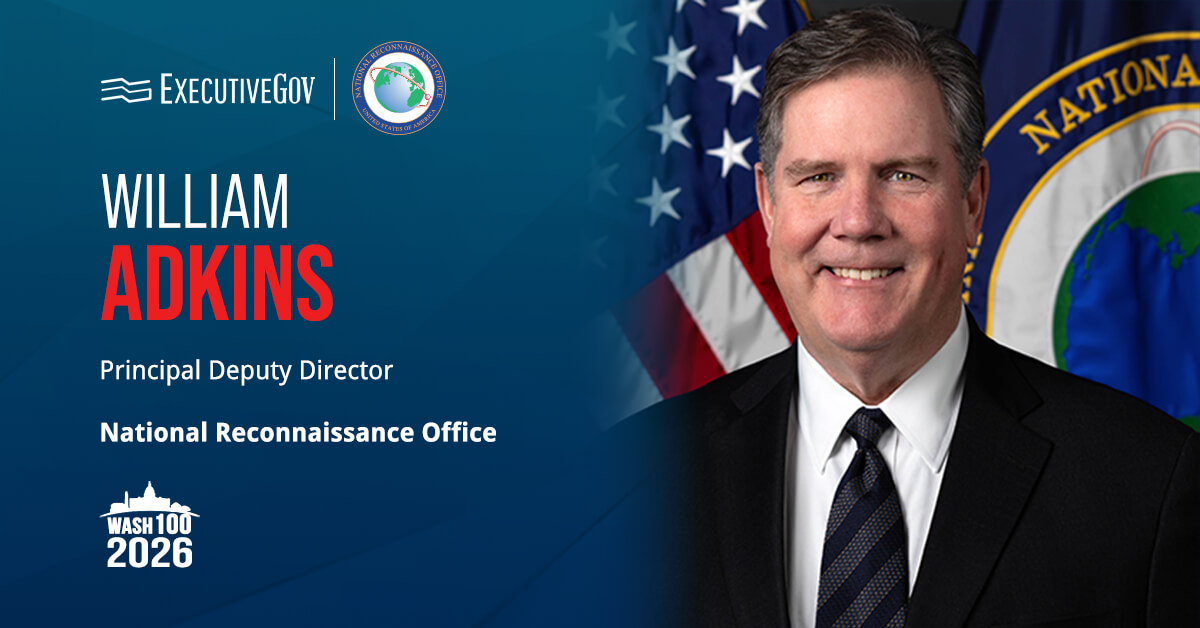
The National Reconnaissance Office’s proliferated architecture recorded more than 400,000 collections in 2025, William Adkins, principal deputy director at NRO, said Tuesday at the annual Space Symposium.

NRO's progress on its proliferated architecture comes as government and industry leaders prepare to discuss the future of space capabilities at major forums. Register now for the 2026 Air and Space Summit and listen to experts as they discuss trends and emerging technologies shaping national security missions across the air and space domains.
Adkins, a 2026 Wash100 awardee, said the architecture is now operational and exceeding expectations two years after the agency introduced the concept.
How Did NRO’s Proliferated Architecture Evolve From Vision to Reality?
The NRO first outlined the proliferated architecture as an aspirational goal at Space Symposium 2024 under then-Principal Deputy Director Troy Meink, who now serves as Air Force secretary and a 2026 Wash100 honoree. The effort aimed to strengthen resilience, improve collection persistence and accelerate data delivery.
Adkins said those goals are now fully realized. The agency has launched more than 200 satellites in recent years, many of which support the proliferated architecture, forming what the NRO describes as the largest U.S. government constellation.
How Do AI & Machine Learning Support the Constellation?
Adkins said artificial intelligence and machine learning are central to the architecture’s performance. These technologies enable adaptive tasking, autonomous satellite operations and enhanced coordination across the constellation.
He noted that the constellation shortens revisit times, increases observational persistence and improves resilience and security.
“Simply put, we are making it harder for adversaries to hide—and harder for them to disrupt our capabilities,” Adkins stated.
Adkins said NRO is also investing in ground systems to advance automation, optimize tasking, increase processing speed and capacity, and deliver visualization tools.
How Does NRO Work With Industry Partners?
Adkins stated that NRO is working with more than 250 prime vendors and 5,000 subcontractors across multiple mission areas. He noted that flexible acquisition approaches are expanding opportunities for startups and non-traditional suppliers.
According to Adkins, commercial partners are contributing to improvements in cost, speed and agility. He cited examples such as radiation-tolerant microelectronics that reduce development timelines and expenses.
He noted that the agency is integrating commercial and classified data to support warfighters, analysts, policymakers and first responders in decision-making.
Proliferated Architecture Launch Missions
In January, NRO announced the launch of the NROL-105 mission, deploying a new batch of satellites to orbit as part of the agency’s proliferated architecture.
Proliferated launches in 2025 include the NROL-48, NROL-145 and NROL-192 missions.