- NASA has realigned mission directorates to support human spaceflight, research and lunar priorities
- The agency will create HSMD and RTMD while keeping the Science Mission Directorate unchanged
- NASA’s Greg Heckler will join a panel discussion at the 2026 Air and Space Summit
NASA has announced an agencywide realignment that restructures several mission directorates as the agency advances objectives outlined in the National Space Policy.

As NASA moves forward with a major mission directorate realignment focused on accelerating human spaceflight, research and technology priorities, government and industry leaders continue to discuss how commercial partnerships can support faster mission delivery. Greg Heckler of NASA will join a panel discussion at the 2026 Air and Space Summit on July 30 to examine commercial space capabilities, mission support and the future of collaboration across the space sector. Sign up now to save your spot!
The agency said Friday the changes are intended to support priorities, including the Artemis program, lunar base development, nuclear space reactor initiatives, and science and discovery missions.
How Is NASA Realigning Its Mission Directorates?
NASA said the Exploration Systems Development Mission Directorate and the Space Operations Mission Directorate will merge into the new Human Spaceflight Mission Directorate, or HSMD. HSMD will oversee human spaceflight activities spanning low Earth orbit and lunar operations.
The agency will combine the Aeronautics Research Mission Directorate and the Space Technology Mission Directorate into the new Research and Technology Mission Directorate, or RTMD.
According to NASA, RTMD will manage research, aeronautics, space technology, nuclear power and propulsion development activities to support current and future missions.
The Science Mission Directorate, or SMD, will remain unchanged and continue overseeing the agency’s science programs and discovery missions.
What Actions Is NASA Taking to Support the Realignment?
NASA said center directors will continue reporting to Associate Administrator Amit Kshatriya to support center capabilities, infrastructure investments and workforce development.
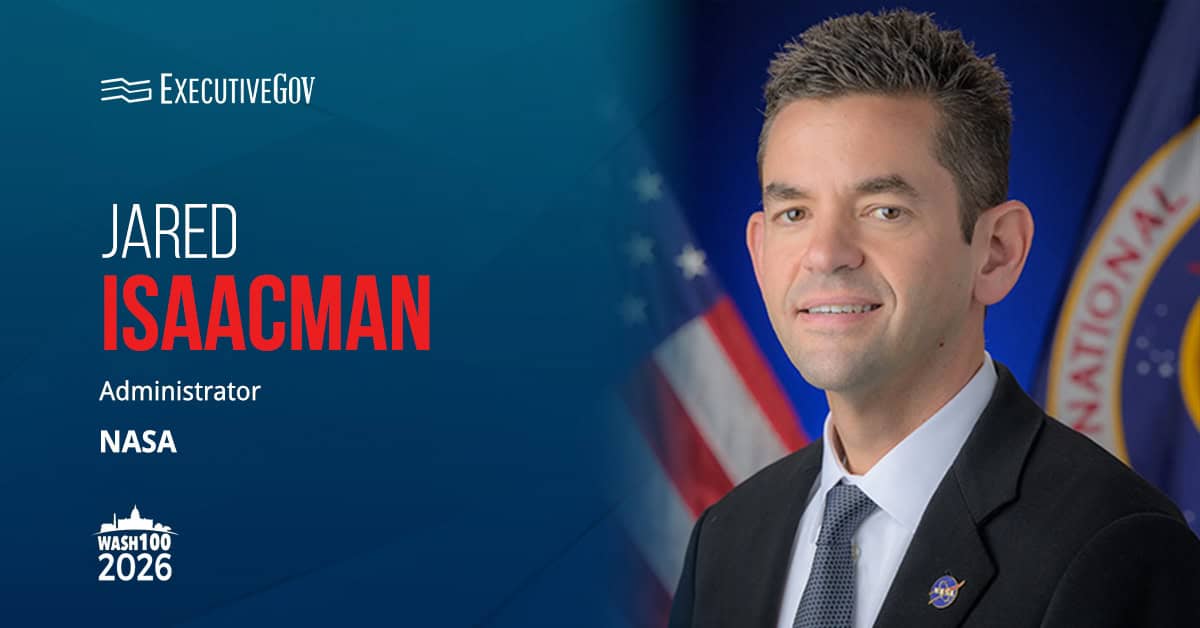
Mission directorates will report directly to NASA Administrator Jared Isaacman to streamline mission execution and coordination across NASA centers, industry partners and international organizations.
In addition, the associate administrator will also serve as NASA’s chief engineer to support technical oversight and engineering decision-making.
The agency said it also continues efforts to rebuild core competencies, expand the intern pipeline, insource contractors to civil servant roles where appropriate and use the NASA Force recruitment initiative with the Office of Personnel Management.
What Did Jared Isaacman Say About the Realignment?
Isaacman, a 2026 Wash100 awardee, said the initiative reflects NASA’s focus on executing missions in support of the National Space Policy.
“We are focusing resources on the most pressing objectives only NASA is capable of undertaking and liberating the workforce from unnecessary bureaucracy and obstacles that impede progress. We aim to rebuild competencies and instill a culture that attracts the best and brightest capable of pursuing the most demanding engineering challenges and moving safely and urgently,” he said.
Isaacman added that NASA does not plan workforce reductions, program cancellations or center closures as part of the changes.
Who Will Serve in NASA’s Updated Leadership Structure?
NASA announced the following leadership assignments related to the reorganization:
- Adam Steltzner, chief engineer for special projects
- Bradley Niese, associate administrator for procurement
- Brian Hughes, director, NASA’s Kennedy Space Center
- Carlos Garcia-Galan, program manager, Moon Base, HSMD
- Cynthia Simmons, deputy director, NASA’s Goddard Space Flight Center
- Dana Weigel, program manager, low Earth orbit, HSMD
- Dave Mitchell, special assignment lead for NASA headquarters relocation
- Dawn Schaible, director, NASA’s Glenn Research Center
- Eli Ouder, acting deputy associate administrator, Mission Support Directorate
- Greg Stover, director, Advanced Research and Technology Division, RTMD
- James Kenyon, associate administrator, RTMD
- Jamie Dunn, director, NASA’s Goddard Space Flight Center
- Jeremy Parsons, program manager, Artemis, HSMD
- Joel Montalbano, deputy associate administrator, HSMD
- John Bailey, associate administrator, Mission Support Directorate
- Kathleen Karika, associate administrator, Office of International and Interagency Relations
- Kelvin Manning, deputy associate administrator, HSMD
- Kevin Coggins, director, SCaN, or Space Communications and Navigation, RTMD
- Laurie Grindle, director, Aeronautics Division, RTMD
- Lori Glaze, associate administrator, HSMD
- Marvin Horne, deputy assistant administrator for Procurement
- Meredith McKay, deputy associate administrator, Office of International and Interagency Relations
- Steve Sinacore, acting director, Space Reactor Office; program manager for SR-1 and LR-1, RTMD
- Wanda Peters, deputy associate administrator, RTMD
- Wesley Deadrick, director, Katherine Johnson IV&V Facility
The agency said Bob Pearce will retire as head of the Aeronautics Research Mission Directorate following a 36-year career at the agency.