- FCC has extended two Covered List exceptions for foreign-produced drones through January 2028
- FCC seeks comment on banning foreign-made military-grade drones for non-government use
- Explore AI and other modernization priorities at the 2026 Air and Space Summit
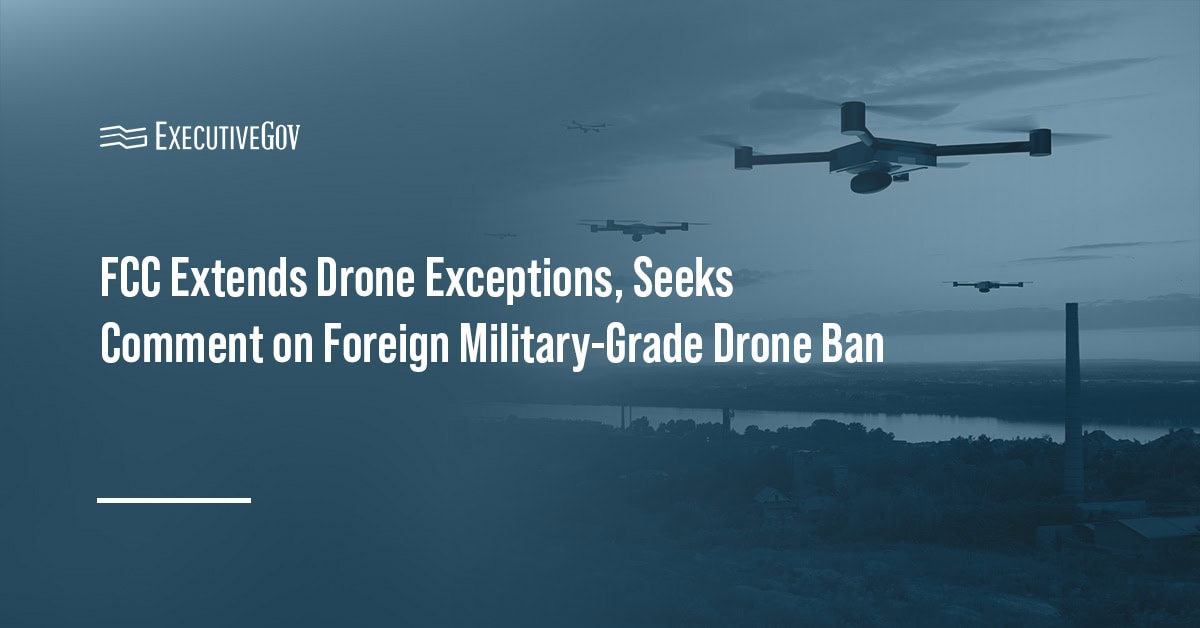
The Federal Communications Commission has extended exceptions to its Covered List ban on foreign-produced drones and drone components and started soliciting comments on whether to prohibit the import and sale of foreign-made military-grade drones for non-government use.

As the government sharpens its focus on unmanned aircraft systems and airspace security, the Potomac Officers Club will host the 2026 Air and Space Summit on July 30. Government and industry leaders will gather to discuss artificial intelligence, commercial space relay and other priorities shaping the future of air and space acquisition. Save your seat now and join the conversation.
What Changes Has FCC Made to Covered List Exceptions for Drones?
FCC said Tuesday the Public Safety and Homeland Security Bureau, or PSHSB, has extended two existing exceptions to the agency’s Covered List ban on foreign-produced drones and UAS components.
The commission’s Covered List is a list of communications equipment and services identified as posing potential risks to U.S. national security and the safety of individuals.
The bureau said Tuesday it will continue permitting new authorizations for equipment on the Department of War’s Blue UAS List and for equipment meeting the Buy America standard, which requires U.S. assembly with at least 65 percent of component value produced domestically. Both exceptions, previously set to expire Jan. 1, 2027, now run through Jan. 1, 2028.
PSHSB also removed the expiration date entirely for foreign-produced UAS and UAS critical components that have received Conditional Approval from DOW following a commitment to onshore production. FCC said the combined actions give industry certainty that equipment determined not to pose national security risks will not face imminent new restrictions.
What Comments Is FCC Seeking on the Proposed Military-Grade Drone Ban?
The commission’s PSHSB and the Office of Engineering and Technology issued a public notice seeking comment on whether to prohibit the import, marketing or sale of certain military-grade foreign-made UAS and UAS critical components already on the Covered List for non-government use. FCC said it tentatively concluded there are strong national security grounds for such a prohibition, citing prior findings that the equipment poses unacceptable risks.
Any prohibition would exclude equipment not on the Covered List, equipment imported or sold for federal government use or for commercial testing and product development, and continued use of drones already purchased.
The notice also asks whether the prohibition should extend to specific categories, including swarming drones; drones designed to integrate defense articles; thermal imaging drones; drones with LiDAR sensing; aerosol drones capable of dispensing regulated agricultural chemicals; drone docking stations; and UAS weighing 55 pounds or more.
Comments are due 30 days after the notice publishes in the Federal Register.
What Other Drone-Related Actions Has FCC Recently Taken?
The commission’s actions mark the latest in a series of FCC moves on drone policy this year. In April, FCC issued a public notice requesting feedback on potential regulatory changes to support the Trump administration’s strategy for U.S. drone dominance.
In March, FCC updated its Covered List to exempt four uncrewed aircraft systems after the Department of War determined they do not pose national security risks. FCC said the decision marked the first set of Conditional Approvals following DOW’s January determination that certain drones and components do not pose national security risks.
The current Covered List traces back to December, when FCC added foreign-made drones and critical UAS components to the list following an interagency finding of national security concerns. The designation blocked affected systems from receiving authorization for import or sale of new models in the U.S.