- Unmanned systems have moved from experimental to operational across five distinct mission sets in the past year alone
- Combat use is no longer theoretical — Navy-linked USVs have struck real targets and rescued downed aircrew in 2026
- Get the industry perspective on where UUVs and USVs go next at the 2026 Navy Summit!
Unmanned underwater vehicles and unmanned surface vessels — a.k.a. UUVs and USVs — have quietly become one of the U.S. Navy’s fastest-moving technology stories. The Navy’s interest in the technology is nothing new — UUVs cleared mines at Umm Qasr during Operation Iraqi Freedom in 2003, and DARPA and the service ran a joint UUV development program as far back as 1988. What’s changed is the pace and scale: a technology that spent decades as a niche, experimental capability has, in 2026, turned into combat-tested hardware doing real missions at scale — hunting mines in the Strait of Hormuz, striking targets inside Iran and pulling downed pilots out of the water. Below are the five mission areas defining that shift.
Hear directly from the technologists and operators steering that shift at the Potomac Officers Club’s 2026 Navy Summit panel, The Future of UUV & USV Navy-Industry Partnership on Aug. 27, featuring:
- RDML (Ret.) Anthony Lengerich, vice president of naval programs, Thales Defense & Security
- Van Gurley, CEO, Metron Inc.
- Chris Fraser, senior vice president for delivery and implementations, Exiger
- Glenn Hickok, vice president of Noblis Defense and president of Noblis MSD, Noblis
Save your spot at this highly anticipated GovCon event today!
What Are Leading UUV and USV Use Cases at the Navy?
1. Anti-Submarine Warfare
The Medium Unmanned Surface Vessel, or MUSV program, centered on the roughly 135-foot prototypes Sea Hunter and Seahawk, functions as a distributed sensor network — extending the reach of manned ships and feeding them real-time data to support anti-submarine warfare and maritime domain awareness. The Pacific Fleet stood up Unmanned Surface Vessel Division One in 2022 to manage MUSV experimentation and fleet integration, and the program has since moved well past the test phase.
Surface Development Group One commodore Garrett Miller announced at the Surface Navy Association’s January 2026 symposium that Seahawk and Sea Hunter would leave the experimental sandbox and deploy operationally this year, with Seahawk slated to join a carrier strike group, The Defense Post reported. Leidos holds a 2022 task order to design and build a follow-on medium USV, while Textron Systems landed a 2025 contract covering software, payload integration and testing for mine-countermeasures USVs — part of a small-USV fleet that grew from four units to hundreds across 2025 alone.
2. Undersea and Seabed Warfare
Boeing’s Orca Extra Large Unmanned Undersea Vehicle, dubbed XLUUV, an 85-foot, 85-ton autonomous diesel-electric “unmanned submarine” built with HII, can deploy and recover directly from pier-side facilities without a manned mothership, handling ISR, mine warfare (including covert minelaying via a 34-foot modular payload bay), seabed warfare and eventual strike support. The Navy accepted its first XLUUV test asset from Boeing in December 2023, and former Chief of Naval Operations Adm. Lisa Franchetti toured Boeing’s Orca manufacturing facility to highlight the program.
The Navy formally shifted Orca from experimental development into planned fleet acquisition under its FY2026 shipbuilding plan in May, funding two vehicles in FY2027 and 16 through FY2031 — alongside a parallel buy of 47 MUSVs — as part of a distributed autonomous warfare strategy focused on the Pacific, The Defense News reported.
Multi-mission undersea autonomy is advancing on a parallel track. Raytheon, an RTX business, and Composite Energy Technologies announced Aug. 10 that they had successfully demonstrated the undersea launch capabilities of HADALUS, a low-cost, long-endurance UUV, during a recent Navy exercise — marking the first time the service had seen that integrated capability in the water and pointing toward a single platform that can detect, reacquire and engage within one mission. Anduril is chasing similar ground, having delivered its first Dive-LD to the Navy’s Unmanned Undersea Vehicle Squadron 1, Defence Industry reported. The larger Dive-XL was selected by the Defense Innovation Unit in March 2026 for the Combat Autonomous Maritime Platform Project, which requires vehicles to travel beyond 1,000 nautical miles and dive past 200 meters in GPS-denied waters, according to Naval News.
3. Kinetic Strike and Offensive Operations
No mission set has moved faster than armed, one-way-attack surface drones. The Navy awarded Saronic a $392 million production contract for its Corsair autonomous surface vessel in December 2025, with then-Secretary of the Navy and Wash100 Award winner John Phelan noting the program went from prototype to production in under 12 months, gCaptain reported. Corsair is a 24-foot modular vessel that can carry roughly 1,000 pounds over 1,000 nautical miles at speeds exceeding 35 knots, built for missions spanning maritime domain awareness to kinetic and non-kinetic strike.
That capability went from contract to combat in about seven months. CENTCOM confirmed the first-ever U.S. combat use of unmanned surface vessels on July 12–13, employing three Corsairs as one-way attack drones against a submarine and ship-maintenance facility at Iran’s Bandar Abbas Naval Base, striking a Ghadir-class midget submarine suspended pierside and degrading Iran’s ability to keep attacking commercial shipping, DefenseScoop reported. Separately, the Navy’s own Unmanned Surface Vessel Division 32 conducted the service’s first GARC live-fire strike against the decommissioned ex-USS Peleliu during RIMPAC 2026, having previously deployed the BlackSea Technologies-built platform with NATO during BALTOPS 2026 — an organic Navy development track running parallel to the Saronic contract.
Panelist Chris Fraser’s firm, Exiger, focuses on the supply-chain and third-party risk side of exactly this kind of rapid-fielding push — a theme he’ll bring to the Navy Summit stage when he discusses how the Navy and its industry partners are learning to move at “war-footing speed” without losing track of who is actually building the hardware.
Secure your seat at the 2026 Navy Summit now!
4. Maritime Domain Awareness and ISR
Task Force 59, stood up in September 2021 as the Navy’s first Unmanned and Artificial Intelligence Task Force, integrates unmanned systems and AI across 5th Fleet’s roughly 2.5-million-square-mile area of responsibility and has tested, upgraded or operated more than 23 different unmanned systems. Contractor-built USVs like Saildrone’s Explorer/Voyager and MARTAC’s T-38 Devil Ray have logged extended patrols, while subordinate command Task Group 59.1 has run exercises testing over-the-horizon comms and autonomous UAV launch and recovery from a USV.
The mission is spreading well beyond the Middle East. U.S. 4th Fleet has been using USVs to map trafficking routes across the Caribbean Sea and Gulf of Mexico, extending the TF 59 model into counter-narcotics work, according to Saildrone. A Saronic Corsair operated by Task Force 59 also located and recovered two U.S. Army AH-64 Apache crew members who had gone down in the Gulf of Oman on June 8-9, with CENTCOM confirming the Corsair had been fielded in theater since late March, DefenseScoop reported — showing how ISR-postured USVs are now doubling as personnel-recovery assets.
5. Mine Countermeasures and Force Protection
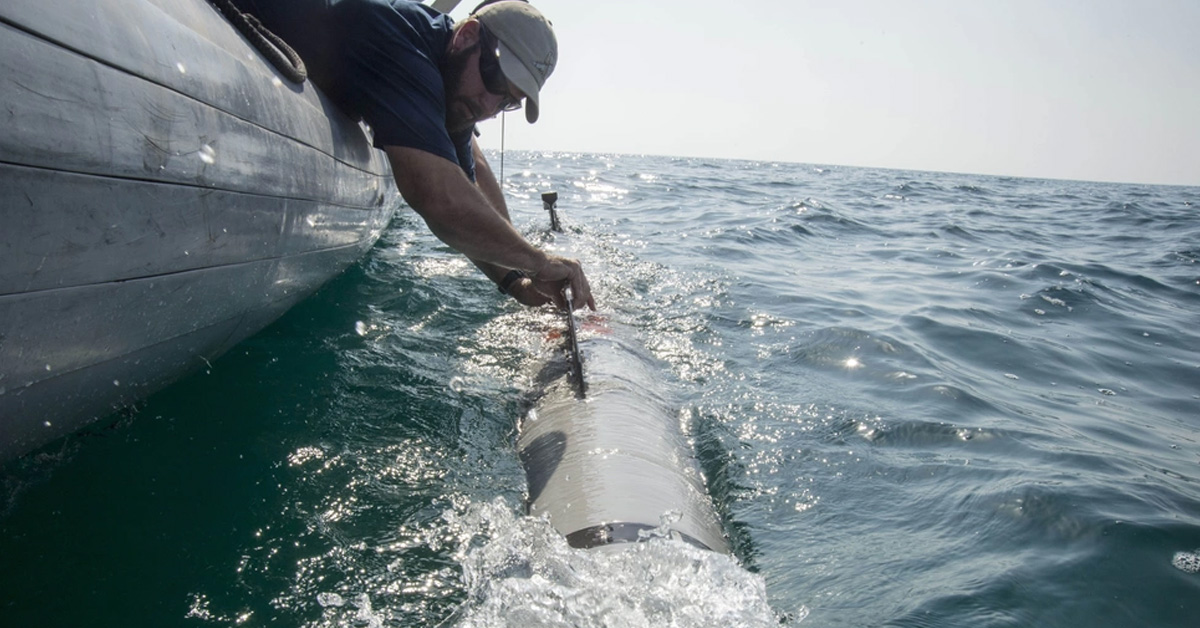
Mine countermeasures, a.k.a. MCM, remains the Navy’s most proven UUV/USV mission, and its reach now extends into the force-protection and harbor-security work once handled separately. The Navy’s robotics-enabled MCM Mission Package reached initial operational capability in 2023, letting a Littoral Combat Ship or vessel of opportunity hunt, neutralize and sweep mines using an MCM USV built by Textron Systems that tows an AQS-20 sonar, plus an MH-60S helicopter and supporting equipment. General Dynamics’ Knifefish, a medium-class UUV, detects and classifies buried mines and mines in high-clutter environments as an off-board sensor, while HII’s Mk 18 Mod 2 Kingfish/Swordfish family has delivered more than 90 vehicles to the fleet since 2012.
Smaller, portable systems round out the mission and cover the ports and harbors themselves. The EOD HULS (MK 19), built on Bluefin Robotics’ hovering autonomous underwater vehicle, searches ship hulls and harbor floors for limpet mines and IEDs — reducing risk to Navy divers — while HII’s REMUS 300, the Navy’s next-generation Small UUV program of record since March 2022, handles mine countermeasures, hydrographic survey and rapid environmental assessment from a two-person-portable platform. HII received an order from Hitachi in July 2025 for more than a dozen REMUS 300 vehicles, reflecting continued demand for man-portable systems in these force-protection roles, Naval Technology reported.
The mission’s biggest real-world test came in April 2026, when CENTCOM announced that underwater drones would join the effort to clear Iranian-laid mines from the Strait of Hormuz, following guided-missile destroyers USS Frank E. Peterson and USS Michael Murphy transiting the strait to begin establishing safe passage — building on the Navy’s first two operational LCS mine-countermeasure deployments, from USS Santa Barbara and USS Canberra out of San Diego in 2025.
Why Should GovCons Attend the Navy Summit Panel on UUVs and USVs?
Every mission above sits at the center of the Department of War’s biggest maritime bets. Unmanned vessels are a core piece of the Golden Fleet, designed to operate alongside Trump-class warships, and they’re the fulcrum of AUKUS Pillar II, which requires system delivery by 2027. That is exactly the terrain covered by the Navy Summit panel, The Future of UUV & USV Navy-Industry Partnership.
Here’s a closer look at the four industry leaders who will unpack it:
- RDML (Ret.) Anthony Lengerich serves as vice president of naval programs at Thales Defense & Security, bringing a career naval officer’s perspective to how unmanned systems get built, tested and fielded alongside the fleet he once served in.
- Van Gurley leads Metron Inc. as CEO, overseeing a firm known for the modeling, simulation and analytics work that underpins how the Navy plans and evaluates unmanned mission sets.
- Chris Fraser serves as senior vice president for delivery and implementations at Exiger, focused on the supply-chain and third-party risk questions that come with fielding unmanned hardware at the speed the Navy now demands.
- Glenn Hickok holds a dual role as vice president of Noblis Defense and president of Noblis MSD at Noblis, giving him a broad view of how mission-support and systems-engineering work translates into fielded unmanned capability.
Together, they’ll dig into the technical demands separating UUVs from USVs, how the underlying technology has evolved over the past few decades, and the hard-won lessons of working alongside naval personnel in a market that’s only getting more crowded. Attendees will leave with concrete guidance on diversifying their unmanned portfolio and aligning with the Department of the Navy’s mission.
Make sure your organization is represented at this elite meeting of the minds.