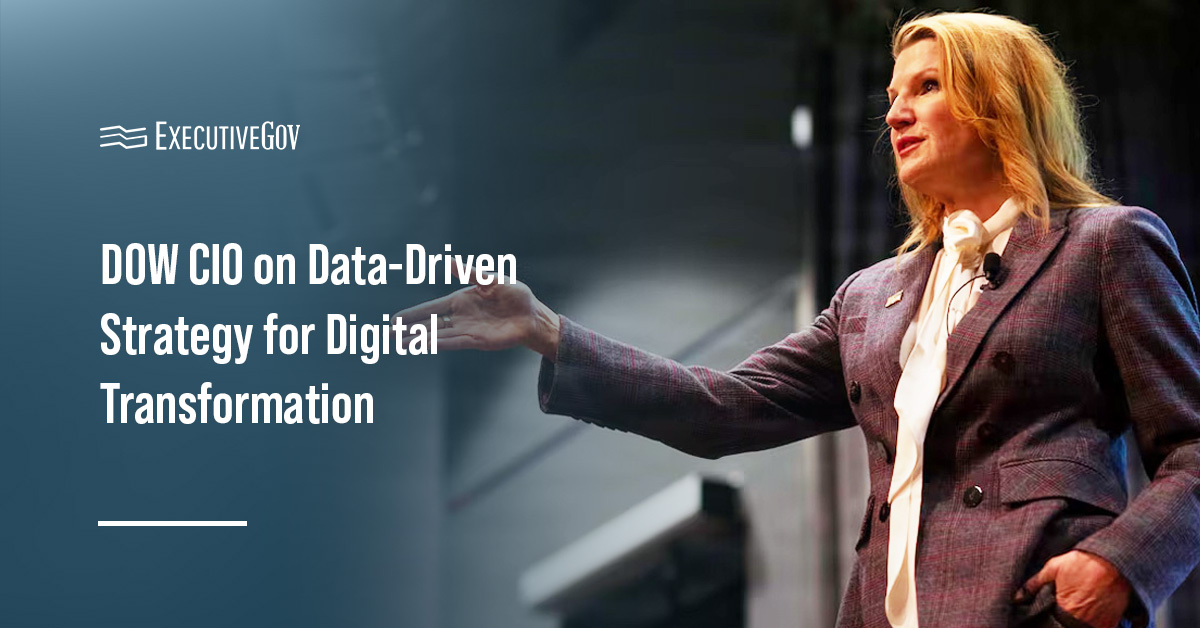
In testimony before the Senate Armed Services Subcommittee on Cybersecurity in late March, Pentagon Chief Information Officer and Wash100 Award winner Kirsten Davies outlined a strategy focused on breaking down legacy system silos, standardizing data architectures and accelerating the delivery of real-time analytics to warfighters at the tactical edge.
Davies emphasized that the department’s modernization push is centered on turning vast, distributed data into actionable insight through a unified digital ecosystem, shifting from fragmented IT environments to an integrated, data-centric model that supports continuous operations, enhances situational awareness and strengthens mission effectiveness.
 Davies is keynoting the 2026 Digital Transformation Summit on April 22, providing a unique forum for government and industry leaders to gain firsthand insight from the Pentagon’s top ranking information officer on how data-centric strategies are shaping the future of defense modernization. Save your seat to secure your place in the conversation.
What Role Does Data Play in Modern Warfighting Strategy?
The Department of War is undertaking a sweeping digital transformation effort to restructure how data is collected, integrated and operationalized across its enterprise, with the goal of enabling faster, more informed decision-making in complex environments.
At the core of the department’s modernization strategy is the concept of transforming data into an operational advantage. During her recent testimony, Davies underscored the importance of accelerating data flows across the enterprise and ensuring that critical information is accessible at the point of need:
“Establishing clear data architecture frameworks will enhance the availability of data, further improving data insights across our ecosystem for every situation.”
A key initiative supporting this effort is the development of a common operating picture, designed to aggregate and deliver real-time insights from across the joint force. This capability enables synchronized operations and enhances situational awareness, allowing decision-makers to act with greater speed and precision.
By prioritizing data integration and accessibility, the department aims to move beyond siloed systems and create a unified information environment that supports mission execution across domains.
How Is Data Driving Decision Dominance?
Davies told the Senate, “The operational realization of data superiority and decision dominance is the hallmark of the success of our strategic transformation journey – so this is what we will deliver.”
She explained that achieving decision dominance requires more than data collection; it demands the ability to process, analyze and act on information at the speed of relevance. The DOW is therefore investing in modern data architectures, cloud-enabled platforms and analytics tools that support rapid decision-making.
“Our modern and agile delivery approach means that when a new requirement emerges in a combined operation, we can deliver the necessary software application, analytics tool, and data, not just to our warfighters and commanders, but also to our partners, with security and speed, leveraging an intuitive user experience,” Davies said.
These efforts are designed to empower warfighters at the tactical edge while ensuring that enterprise systems remain resilient and secure. The focus on speed and quality of decision-making reflects a broader recognition that future conflicts will be shaped by the ability to outpace adversaries in the information domain.
As Davies noted, the race for data superiority is continuous, requiring sustained innovation and alignment across technology, operations and strategy.
Davies to Spotlight Data Modernization at 2026 Digital Transformation Summit
Be the first to hear Kirsten Davies expand on these themes at the 2026 Digital Transformation Summit on April 22. The event will bring together government and industry leaders to discuss emerging protocols, data strategies and modernization priorities shaping the federal landscape.
Davies’ participation underscores the growing importance of data-centric transformation initiatives across the defense community, particularly as agencies seek to operationalize digital capabilities to support mission success.
Her insights at the summit are expected to highlight how organizations can align digital services technology investments to advance data superiority and decision dominance in modern government operations.