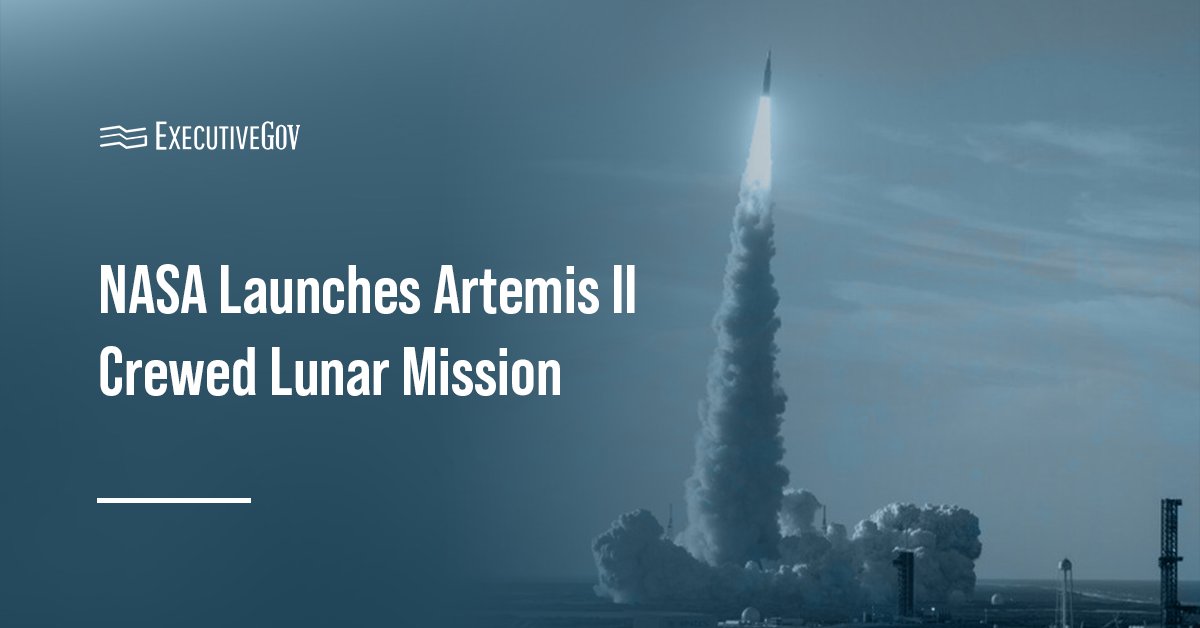
NASA launched four astronauts aboard the Artemis II mission Wednesday evening, marking the first crewed flight around the moon in more than five decades.

The Artemis II launch marks a renewed push in lunar exploration and highlights the growing collaboration between government and industry in advancing space capabilities. Sign up now for the 2026 Air and Space Summit and join leaders as they discuss the technologies and strategies shaping the future of space missions.
The agency said Wednesday its Space Launch System rocket lifted off from a launch pad at Kennedy Space Center in Florida, sending the Lockheed Martin-built Orion spacecraft into space for a planned 10-day mission.
Orion is carrying NASA astronauts Reid Wiseman, Victor Glover and Christina Koch, along with Canadian Space Agency astronaut Jeremy Hansen.
“Artemis II is the start of something bigger than any one mission. It marks our return to the Moon, not just to visit, but to eventually stay on our Moon Base, and lays the foundation for the next giant leaps ahead,” said NASA Administrator Jared Isaacman, a 2026 Wash100 awardee.
Following launch, Orion deployed its solar arrays and began initial system checkouts as teams transitioned the spacecraft into flight operations.
What Are the Objectives of the Artemis II Mission?
Artemis II is the first crewed test flight of NASA’s Artemis program and is designed to demonstrate the spacecraft's systems with astronauts on board. The mission will test life support systems in a crewed environment, evaluate spacecraft performance in deep space and collect data to support future lunar surface missions.
NASA said the effort will help lay the foundation for sustained human presence on the moon and inform preparations for future missions to Mars.
What Are the Features of the Orion Spacecraft?
According to Lockheed, the Orion spacecraft, named “Integrity” by its crew, includes multiple systems designed to support astronauts during deep space travel. These include environmental control and life support systems, updated flight displays and controls, and audio communications capabilities that incorporate a laser communication system.
Orion is also equipped with a launch abort system designed to enhance crew safety. The spacecraft carries onboard provisions, such as exercise equipment, potable water, a galley, a waste management system, and a hygiene bay to support astronauts during the mission.
“Today's launch is just the beginning of this mission, where we look forward to testing the Orion systems and proving it will be capable of transporting crews to the lunar surface and return them home,” said Robert Lightfoot, president of Lockheed Martin Space.
“This historic moment marks a renewed journey to the Moon and a critical step toward future crewed landings,” added Lightfoot, a three-time Wash100 Award recipient.
What Activities Will Astronauts Conduct During the 10-Day Mission?
During the mission, Orion will travel on a free-return trajectory around the moon, carrying the crew thousands of miles beyond the lunar far side. Astronauts will conduct system checkouts and performance evaluations, perform a manual piloting demonstration, and carry out proximity maneuvering tests to validate spacecraft handling. They will also observe and photograph the moon’s surface during a planned lunar flyby on Monday, April 6.
The spacecraft will first enter a high Earth orbit before executing a translunar injection burn to begin its journey toward the moon. After completing the lunar flyby, Orion will return to Earth and is scheduled to splash down in the Pacific Ocean on April 10.