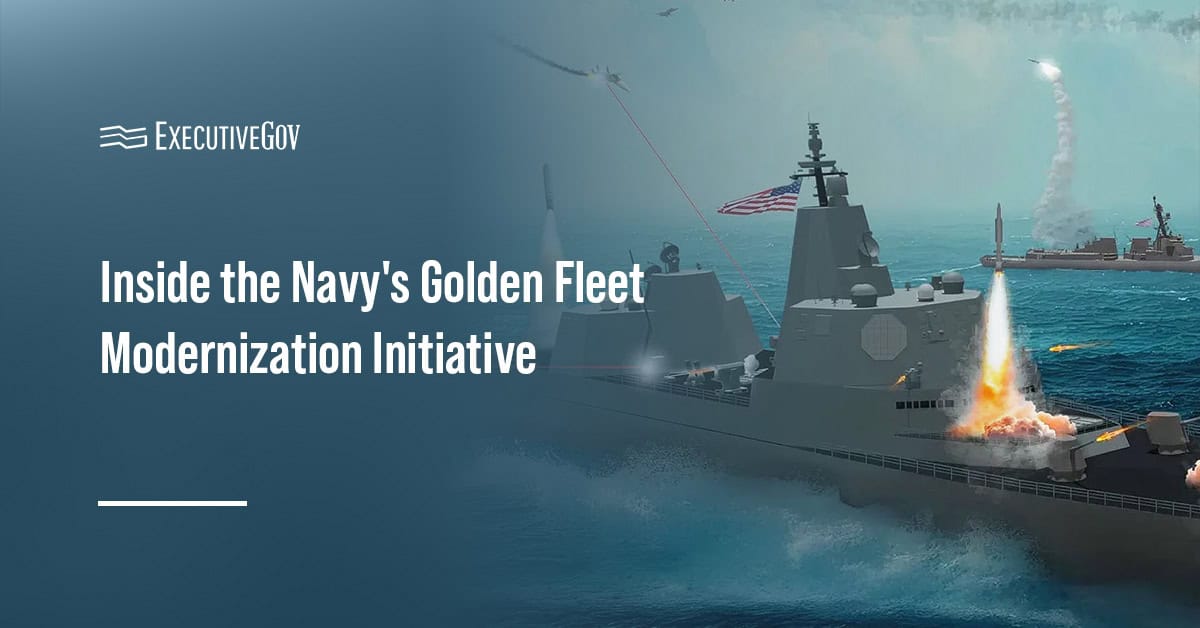
- The Navy’s Golden Fleet will feature Trump-class battleships, which are poised to become the largest U.S. surface combatants since World War II
- The Navy has also announced the medium unmanned surface vessel program as part of the transformation initiative
- The 2026 Navy Summit will host a dedicated panel on Golden Fleet featuring speakers from the Navy and the defense industry
China is aggressively building its naval power, threatening U.S. maritime superiority. To maintain dominance, the U.S. Navy is building a larger, more lethal force under a new transformation initiative.
Announced in December 2025, Golden Fleet aims to revitalize the U.S. shipbuilding industry, cut through bureaucracy and speed up acquisition, and deliver President Donald Trump’s vision of a future naval force capable of countering near-peer adversaries.

The leaders who are spearheading the Navy’s Golden Fleet transformation will share more insights and directly communicate with industry what capabilities the service will need to strengthen naval power at the Potomac Officers Club’s 2026 Navy Summit on Aug. 27. Shery Thomas, enterprise IT officer at the Navy Installations Command, and other defense officials are joining the Building the Golden Fleet With Software: AI, Digital Engineering and the New Shipbuilding Stack panel. Tickets are now available here!
What Is Golden Fleet?
According to Real Clear Defense, the plan is to build a “barbell-shaped fleet,” with fewer large and heavily armed surface combatants operating alongside a greater number of small unmanned and minimally crewed ships.
People familiar with the matter shared in a Janes report cited by the Heritage Foundation that the Navy’s future fleet design will likely have:
- Nine aircraft carriers
- 73 small combatants (excluding medium unmanned surface vessels)
- 67 large surface warships
- 12 ballistic missile submarines
- 54 attack submarines (excluding landing ship medium amphibious warships)
- 27 large amphibious warships
The U.S. Navy currently operates a fleet of 293 battle force ships, below the congressionally mandated requirement of 355. Its latest Battle Force Ship Assessment and Requirement, which was issued in 2023, estimates that the service needs 381 manned ships and 134 unmanned platforms to meet warfighting needs.
In contrast, China now holds the title of the world’s largest navy, with a battle force of over 370 platforms. Beijing’s battle force is expected to grow in the coming year.
The U.S. Navy is targeting a fleet of 299 battle force ships, 68 auxiliary ships and 83 unmanned vessels by fiscal year 2031, according to a shipbuilding plan issued in May.
“This is not merely a course correction; it is a generational undertaking to restore America’s position as a seapower state,” Acting Navy Secretary Hung Cao, a 2026 Wash100 winner, said about Golden Fleet in his foreword of the shipbuilding plan. “It requires a clear-eyed strategy, sustained investment, and a direct commitment to the American worker who builds the ships and the sailor and marine who sail them into the fight.”
During a speech at an event covered by National Defense Magazine in April, Chief of Naval Operations Adm. Daryl Caudle said the ongoing conflict in Iran is a demonstration of the Golden Fleet concept.
“Simply put, the Golden Fleet initiative designs our combined forces to connect our foundry to the fleet and our fleet to how we fight,” he stated. “It creates a continuous engine that can produce, adapt and employ combat power faster than any adversary.”
Cao will deliver the opening keynote at the Potomac Officers Club’s 2026 Navy Summit on Aug. 27. The Navy leader is expected to share insights about the Golden Fleet and other priorities, including naval modernization and defense acquisition reform. Sign up today to learn about America’s future naval force!
What Do We Know About Trump-Class Battleships?
The Trump-class surface combatants will stand as the centerpiece of the administration’s Golden Fleet initiative. Unveiled in December, the ships are expected to be thrice the size of Arleigh Burke-class destroyers and weigh 30,000 to 40,000 tons — making them America’s largest surface combatants since World War II.
“They’ll be the fastest, the biggest and, by far, 100 times more powerful than any battleship ever built,” Trump stated via Breaking Defense.
According to the Navy, the Trump-class ships can operate independently, provide integrated air and missile defense capabilities as part of a Carrier Strike Group, or lead a Surface Action Group for Surface and Anti-Submarine Warfare missions. The ships will have advanced deep-strike weapons and will be able to launch conventional prompt strike hypersonic missiles.
The first of the Trump-class battleships, USS Defiant, will be equipped with SPY-6 radar arrays, Block III Surface Electronic Warfare Improvement Program systems, missile launchers and guns. Sources also revealed to USNI that the surface combatant’s design leaves room for future integration of additional weapons, including nuclear-armed sea-launched cruise missiles and a 32 megajoule rail gun.
USS Defiant will be “the largest, deadliest and most versatile and best-looking warship anywhere on the world’s oceans,” said former Navy Secretary John Phelan, a 2026 Wash100 recipient.
The ship, currently in design phase, is expected to begin construction in the early 2030s.
The Navy estimated that USS Defiant will cost over $17 billion to build, and the service expects to spend $43.5 billion on the first three Trump-class ships, Defense and Security Monitor noted.
What Is the Navy’s Medium Unmanned Surface Vessel Program?
In March, the Navy announced the medium unmanned surface vessel, or MUSV, family of systems and a new marketplace as part of the Golden Fleet rapid acquisition initiative. The effort skips the traditional prototyping phase to accelerate the delivery of autonomous capabilities, Naval News reported.
The Navy plans to conduct shortened test campaigns throughout the summer and then have production-ready vessels in fiscal 2027.
Rebecca Gassler, portfolio acquisition executive for robotic and autonomous systems, told reporters that the Navy intends to “qualify as many MUSV vendors” as possible for the marketplace.
The MUSV program replaces the modular attack surface craft, also known as MASC, effort. According to Gassler, MASC was launched for a single use case.
“As we look across Golden Fleet, and look across where we could use these vessels, we bring ourselves to realize there’s a number of missions we could use these vessels for,” the official added.
How Much Funding Is Expected for the Golden Fleet Initiative in FY27?
The White House’s record $1.5 trillion budget proposal for the Department of War already sets the Golden Fleet plan in motion.
Business Insider reported that the administration allocated $65.8 billion of the request for Navy shipbuilding, which includes initial funding for Trump-class surface combatants. The funding will also cover the construction of 18 battle force ships and 16 non-battle force ships.
“The budget restores the readiness and lethality of the force by ensuring America’s warfighters are trained, equipped, and medically ready to fight and win,” the White House’s budget overview stated.
To hear more about the Navy’s Golden Fleet and other initiatives, join the 2026 Navy Summit on Aug. 27. Event speakers also include Vice Adm. Michael Vernazza, commander of the Naval Information Forces, and Vice Adm. Brad Skillman, deputy chief of naval operations for integration of capabilities and resources. Secure your tickets today!