
- DAF has advanced AI-enabled battle management through the MASH experiment
- Col. John Ohlund said AI can help operators process data faster and improve decision-making
- The 2026 Air and Space Summit on July 30 will feature AI discussions with defense leaders
U.S. Space Force Guardians collaborated with Air Force personnel during the Multi-Decision Advantage Sprint for Human-Machine Teaming, or MASH, experiment to evaluate how artificial intelligence-enabled battle management tools can support faster decision-making across multiple operational domains, DVIDS reported Wednesday.

As DAF advances AI-enabled battle management capabilities, government and industry leaders will continue those discussions at the Potomac Officers Club’s 2026 Air and Space Summit on July 30. Advanced Battle Management System CFT Leader Col. John Ohlund is scheduled to participate in a panel discussion on the role of AI in supporting the modern warfighter alongside other defense and industry leaders. Register now to hear firsthand how AI is shaping the future of air and space operations.
Hosted in Las Vegas, the two-week experiment brought together software developers and military operators to assess the integration of AI and automation services developed during previous Decision Advantage Sprint for Human-Machine Teaming events.
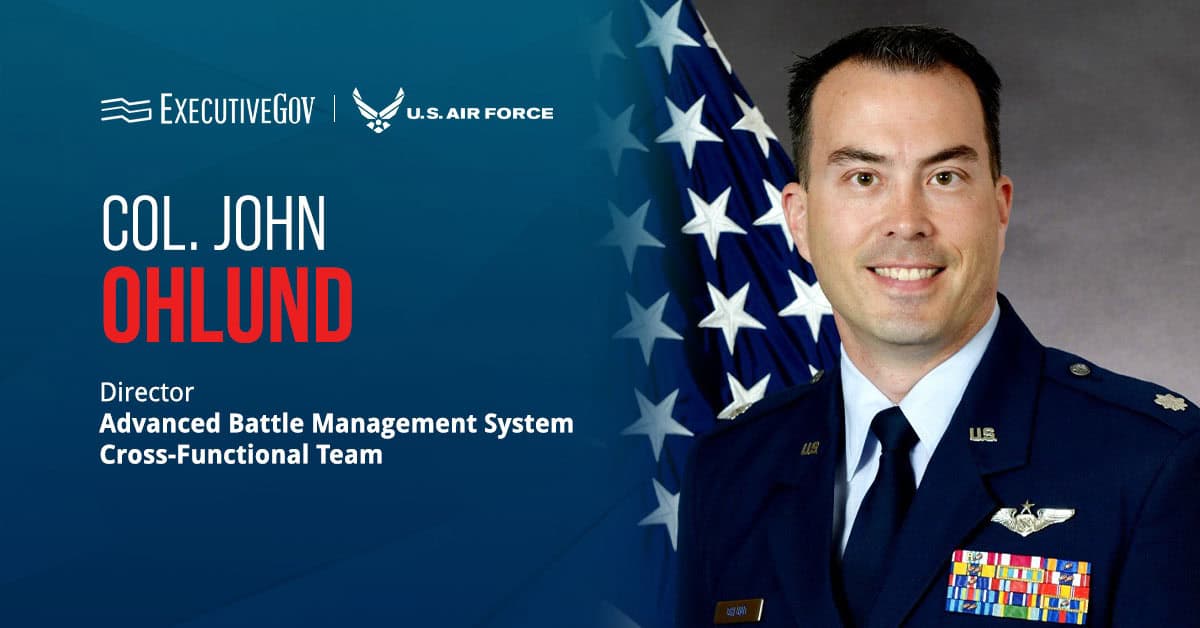
“The Combined Joint All-Domain Command and Control Campaign Plan demands that we make better, timelier decisions,” said Col. John Ohlund, director of the Advanced Battle Management System Cross-Functional Team at the Air Force. He said incorporating AI into the battle management architecture enables operators to rapidly process large volumes of data and deliver effects faster.
Why Does Battle Management Require Multidomain AI?
Ohlund said the future operating environment requires software capable of solving multidomain problems because future conflicts will span the air, space, maritime, cyber and ground domains.
“The reason we challenge the software to solve multi-domain problems is because that’s the reality of the future fight,” Ohlund stated.
He said Air Force air battle managers do not have the authority to execute space or cyber effects, but they are responsible for preparing information and presenting decision options for commanders. According to Ohlund, the goal is for computers to evaluate potential multidomain effects and provide commanders with higher-quality decision options faster.
How Did MASH Test AI-Enabled Battle Management Tools?
The MASH experiment tasked six industry software development teams and the Shadow Operations Center-Nellis military software development team with building tools that support three decision functions derived from the DAF’s Transformational Model: Perceive Actionable Entity, Match Effector and Generate Battle Courses of Action.
Ohlund said the Air Force Research Laboratory developed an orchestrator that allows participating companies to exchange data, ontologies and metadata across their software services. He said the experiment demonstrated that a plug-and-play modular approach supports continuous competition and enables the government to choose best-of-breed software services as they mature.
“By demonstrating that diverse, AI-enabled tools can integrate effectively within this model to accelerate the kill chain, the DAF has taken a critical step toward securing decision advantage for the Joint Force,” Ohlund added.