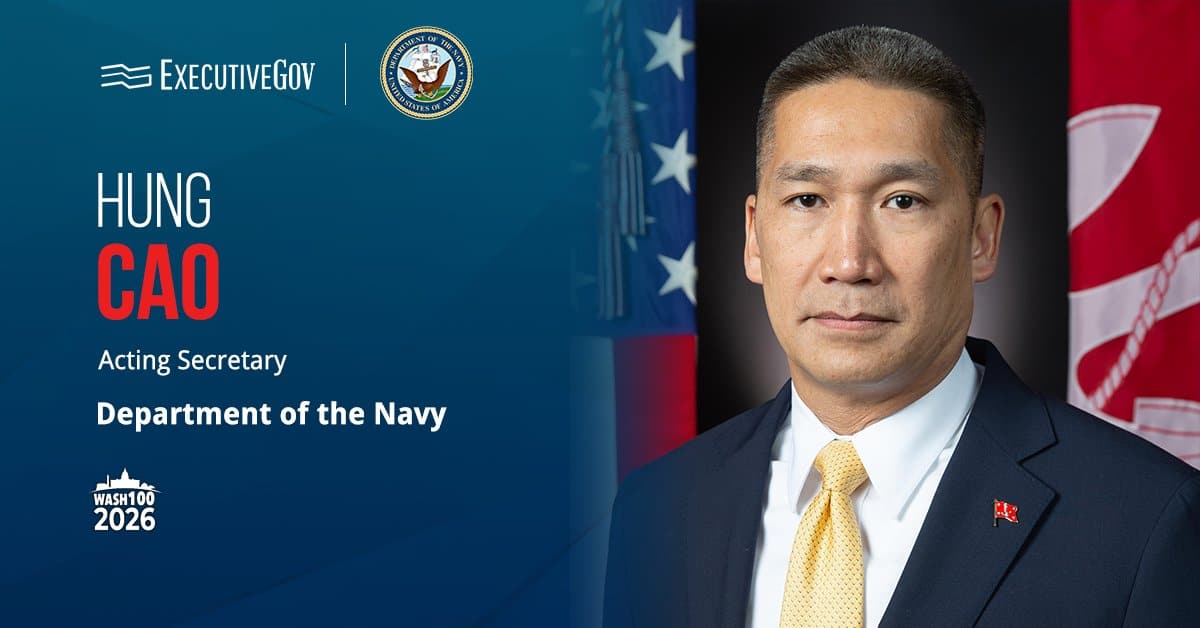
- Acting Secretary of the Navy Hung Cao is consolidating 600-plus networks, launching a department-wide narrative war strategy, and demanding three-month modernization sprints instead of multi-year studies.
- From the USS Ford’s 330-day deployment to a sweeping Navy staff reorg, Cao is governing with a wartime tempo that is reshaping how the department buys, builds and communicates.
- Cao will deliver the opening keynote at the Potomac Officers Club’s 2026 Navy Summit on Aug. 27 — the must-attend event for GovCon leaders tracking where naval modernization money and mission are actually headed.
The Honorable Hung Cao doesn’t have a lot of patience for studies.
The acting secretary of the Navy — and 2026 Wash100 Award recipient and Popular Vote winner — has spent his first months in office telling anyone who will listen that the Department of the Navy is moving too slowly for the threat environment it faces. From consolidating more than 600 fragmented networks to launching a department-wide communication strategy aimed at winning the information domain to reorganizing the Navy staff’s intelligence and communications structure, Cao is governing with a wartime urgency Washington rarely sees.
What makes Cao’s leadership style notable isn’t just the pace — it’s the plainspokenness. In a recent podcast interview with retired Adm. James Foggo at the Center for Maritime Strategy, Cao spoke with the same directness that has characterized his public testimony and written directives: candid about hard tradeoffs, specific about what’s broken and unambiguous about what he intends to fix.

He’ll bring that same forthrightness to the Potomac Officers Club stage on Aug. 27 for Potomac Officers Club’s 2026 Navy Summit. Register today to engage with Acting Sec. Cao and to hear insights on enterprise network modernization, AI, Project Overmatch and much more!
What Are Cao’s Recent Efforts as SECNAV?
Optimize, Secure, Decide: A Combat Framework, Not an IT Roadmap
At the 2026 DON Digital Warfare Symposium West in February, Cao delivered a keynote that landed more like an operational directive than a technology update. He organized his vision around three pillars — optimize, secure and decide — and was explicit that these are a warfighting strategy, not an IT modernization plan.
Optimize targets the Navy’s sprawling, redundant technology estate. With more than 600 distinct networks operating across the service, Cao has called for aggressive consolidation into enterprise-grade services that put mission impact ahead of administrative convenience. His standard is unambiguous: if it doesn’t add warfighting value, it shouldn’t exist.
Secure elevates cybersecurity to the same tier as ships, aircraft and weapons systems. Operating under a zero trust posture and assuming adversary presence aren’t aspirational goals in Cao’s framework — they’re operational requirements. In contested theaters, he has argued, resilient networks are as critical as fuel and ammunition.
Decide is about speed and decision advantage — getting the right data to the right commander at the right moment, connecting sensing to shooting and strategy to execution. For Cao, that’s not a technology problem. It’s a leadership imperative.
Together, the three pillars represent a clear signal to industry: the department isn’t shopping for incremental improvements. It’s building for combat dominance at scale.
What Does Cao Think About AI?
Cao has been notably candid about artificial intelligence — including where it falls short. At the Digital Warfare Symposium, he drew a sharp line between AI as a transformative capability and AI as a patch on broken infrastructure.
“A modern game card won’t work in an Atari console,” he told attendees.
The implication for industry is significant. Cao isn’t interested in AI layered on aging systems. He wants AI embedded at the core of redesigned infrastructure — purpose-built for predictive logistics, real-time commander intelligence and resilient digital operations in critical theaters. That’s a fundamentally different acquisition conversation than the Navy has had for most of the past decade, and it will shape contracting priorities well into the next budget cycle.
No More Studies. No More Delays.
If there’s a single phrase that captures Cao’s governing philosophy, it may be: “No more studies.”
He has called for immediate designation of best-of-breed solutions, aggressive retirement of nonessential systems and modernization timelines compressed from multi-year budget cycles into three-month sprints. The cultural message is equally direct — leaders must accept risk, decide quickly, and move without waiting for perfect solutions. Cao has identified himself as the “prod” in the DON’s “cattle drive” toward consolidation.
That directive applies to industry partners as well. Engagement, Cao has said, is happening at the CEO level, streamlined into two primary channels: mission-driven engineering and integration, and product-focused work through the Defense Innovation Unit.
Why Is Cao Talking About Narrative War?
The Navy’s New Communication Strategy
On June 8, Cao issued a formal Department of the Navy Communication Strategy — an ALNAV message that framed information as a warfighting domain, not a public affairs function.
“We are in a fight for the narrative,” Cao wrote. “Our adversaries compete not only with steel, but with coordinated disinformation designed to undermine our will, divide our alliances and erode the confidence of the American people. We will not cede the information domain.”
The strategy is designed to align the Navy’s enterprise-wide communication posture with White House and Department of War priorities — ensuring that public affairs officers across the service are telling a unified, purposeful story. “Now is the time to tell our story with the reverence, purpose, and precision it deserves,” Cao concluded.
For GovCon audiences, this signals that Navy communication and information warfare work — including contracts tied to Project Overmatch and CJADC2 — will be treated with new strategic seriousness. It also reflects something Cao made clear in his Foggo interview: he views the information domain as inseparable from the physical one, and he brings personal credibility to that view, having led counter-messaging and counter-drone operations in his final military tour.
Those priorities — information warfare, network modernization, AI-enabled decision-making — are precisely what the Potomac Officers Club built the 2026 Navy Summit around. Cao’s Aug. 27 opening keynote will be the most direct, unfiltered access the GovCon community gets to the acting SECNAV’s priorities before the next budget cycle locks in. Panels on Project Overmatch, CJADC2, enterprise network modernization and autonomous systems put the department’s real acquisition agenda on the table — with the program officers and fleet leaders who own it in the room. If your organization does business with the Navy, this is the day you need to be there. Register now.
Building the Team, Fixing the Machine
A Leadership Reshuffling With Purpose
Since taking over as acting SECNAV following John Phelan’s departure on April 22, Cao has been systematically reorganizing his front office — moving Phelan-era appointees into roles where their expertise can contribute while building a closer circle of trusted leaders around himself. In the Foggo interview, Cao was characteristically direct about what he inherited and what he’s changing, including a reversal of his predecessor’s attempt to consolidate intelligence programs under chief of naval intelligence in a structure Cao said ran counter to statute and congressional authority.
The reorganization of N2 and N6 — splitting intelligence back out and pulling communications requirements under N9 to better align with the Intel community — reflects the same logic as his digital modernization agenda: stop building islands, start building connective tissue.
One observable result of the cultural shift: Jason Potter, a long-tenured Senate staffer and Navy veteran who was repositioned by Cao closer to his area of expertise in acquisition, delivered markedly more substantive congressional testimony in May than he had months earlier — a concrete example of what Cao’s empowerment approach looks like in practice.
The Ford, the Troops, and Cao’s Personal Stakes
In the Foggo interview, Cao described flying out to meet the USS Ford strike group in Sicily as the ship made its way home from a 330-day deployment — one of the longest in recent memory, spanning the Eastern Mediterranean, Red Sea combat operations, the Venezuela op, and Operation Epic Fury. He was direct about why he went out rather than waiting for the pier-side ceremony.
“There’s this epidemic of suicide in our military,” he said. “I wanted to look them in the eyes and say, you guys are worth it. You are worth every fight.”
Cao pushed the Presidential Unit Citation through the White House in under a week — a recognition process that normally takes months — and presented it the following Saturday. It’s the kind of fast, visible leadership action that builds credibility with the force.
His investment in sailor welfare extends beyond ceremonies. He has focused on housing consolidation — citing Pacific Beacon in San Diego as the model for unaccompanied sailor housing — and on crisis intervention training at every level of the command structure. He is also candid about why he has skin in the game: his son, Second Lieutenant Cao, graduated from the Naval Academy last month and is entering the Marine Corps.
What’s on the Horizon: Shipyards, Spare Parts and Systemic Reform
Beyond the front office, Cao has signaled ambitions that could reshape the Navy’s physical and logistical infrastructure. Proposed priorities include the creation of a national Navy Battle Depot — a centralized spare parts inventory for every major vessel type, leveraging additive manufacturing where possible — and serious consideration of a fifth naval shipyard on the West Coast to address submarine fleet readiness. He has also taken aim at the Naval Facilities Engineering Systems Command, which critics have long characterized as slow-moving and cost-inefficient. For defense contractors in naval construction or facilities work, Cao’s focus on NAVFAC reform is worth tracking closely.
Don’t Miss Cao’s Keynote at the 2026 Navy Summit
Cao’s opening keynote at the Potomac Officers Club’s 2026 Navy Summit on Aug. 27 is the sharpest single point of access the GovCon community will have to the acting SECNAV’s priorities before the next budget cycle crystallizes. This isn’t a ceremonial appearance — Cao governs at the speed he speaks, and what he says on Aug. 27 will reflect where the department’s money, mission and modernization agenda are actually going.
Alongside Cao, the event features keynotes from Vice Adm. Michael Vernazza, commander of Naval Information Forces, and VADM Brad Skillman, the deputy CNO for Integration of Capabilities and Resources — the budget and resourcing authority whose priorities shape what actually gets funded and fielded. Panels cover autonomy at scale, integrating commercial capabilities into maritime operations centers, AI and digital engineering in shipbuilding, enterprise network modernization for information warfare readiness, Project Overmatch and CJADC2 and a “Go Live Faster” session featuring VADM (Ret.) Joe Kernan and GEN (Ret.) Charles R. Hamilton. Industry voices from Google Public Sector, AT&T, Noblis, Carahsoft, Oracle, Kpler and others round out a program built not for spectators but for decision-makers.
The event runs from a 7 a.m. networking reception through a 4:15 p.m. close. One day. The people setting the Navy’s direction. The conversations that will define naval contracting for the next several years.
Hung Cao will be there. The question is whether you will be too. Save your spot before they’re gone!