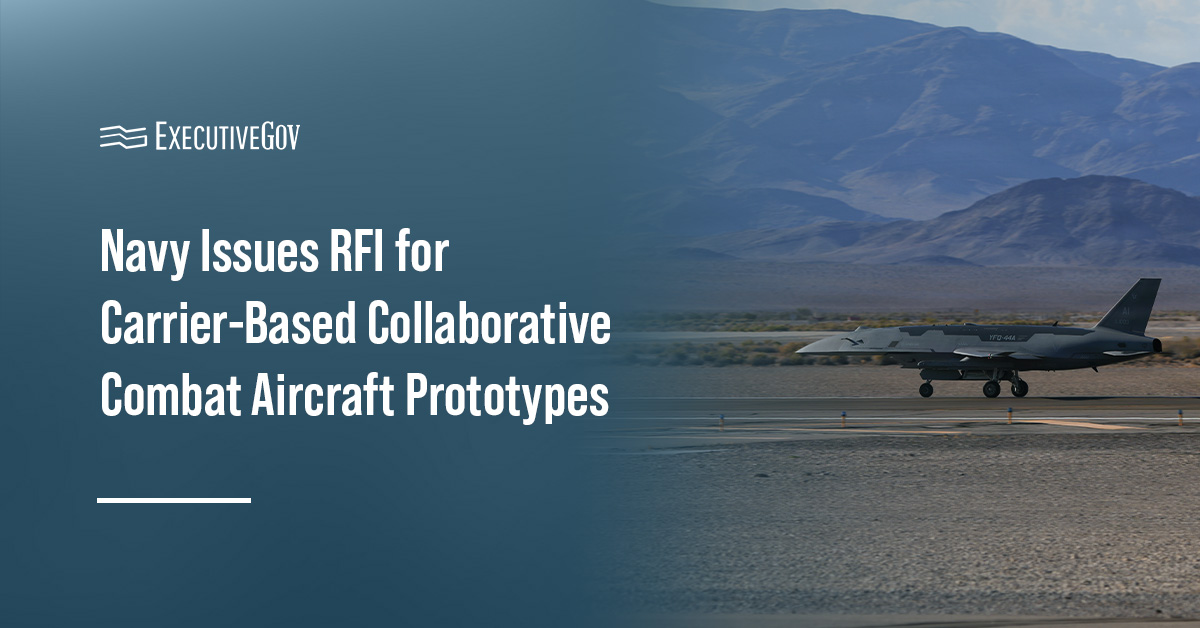
- NAVAIR is seeking two carrier-qualified CCA Increment 1 prototypes within three years of award
- The aircraft must launch from Ford- and Nimitz-class carriers and carry four 2,500-lb weapons
- Responses are due Sept. 18, with an Industry Day set for Sept. 22
The Naval Air Systems Command, or NAVAIR, has issued a request for information seeking industry capability statements for the Navy’s Collaborative Combat Aircraft Increment 1 program. NAVAIR, on behalf of the Future Advanced Capability Program Office, wants two autonomous, carrier-capable prototypes achieving shore-based certification within three years of award.
What Capabilities Must the Navy’s CCA Increment 1 Prototype Deliver?
According to a request for information published Monday on SAM.gov, NAVAIR’s technical requirements matrix calls for a weaponized, extended-range unmanned aircraft capable of catapult takeoffs and arrested landings on Gerald R. Ford-class and Nimitz-class carriers while meeting deck, elevator and hangar bay dimensional limits.
The prototype must carry four weapons of up to 2,500 pounds externally, integrate precision landing systems through JPALS and LANTERNS and operate up to Sea State 5.
NAVAIR requires the aircraft to align with the Modular Open Systems Approach and Autonomy Government Reference Architecture standards that the Department of War is applying across its broader Collaborative Combat Aircraft efforts, along with Open Mission Systems and Universal Control Interface protocols for onboard mission software.
Responses to the RFI will be accepted until Sept. 18, with an Industry Day to follow Sept. 22 at the University System of Maryland at Southern Maryland.
How Would the Prototype Effort Be Structured?
The Government is considering using the Naval Air Systems Consortium to award one or more other transaction agreements under 10 U.S.C. 4022, with the effort structured as a cost-sharing arrangement between performers and the Navy.
NAVAIR expects three years of performance from award, with a Mission Autonomy minimum viable product due at six months, a Platform-in-a-Box model due within 12 months and first flight required no later than 24 months after award.
How Does the RFI Fit Into the Navy’s Broader Unmanned Carrier Aviation Push?
The capability gap driving CCA Increment 1 stems from the Carrier Air Wing’s limited capacity to sustain sea control in highly contested environments as manned fighters face growing survivability risks.
NAVAIR noted that the aircraft will expand the Carrier Strike Group’s operational reach through manned-unmanned teaming with fourth- and fifth-generation fighters, building on infrastructure such as the MD-5 Unmanned Carrier Aviation Mission Control System already used to operate the Navy’s MQ-25A Stingray.
The push also parallels the Air Force’s Collaborative Combat Aircraft program, which has advanced prototype aircraft through flight testing under a separate acquisition track.