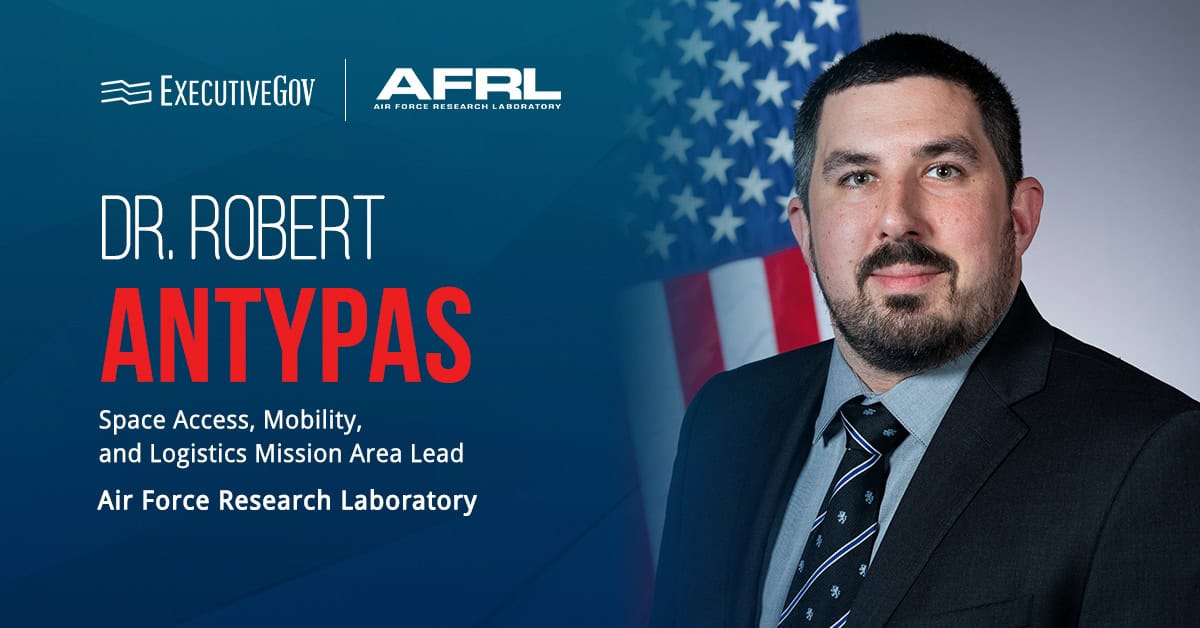
- AFRL is back to awarding SBIR contracts to industry after a six-month lapse following the reauthorization of the SBIR/STTR programs.
- The lab will continue using that model of partnering with industry and acquisition partners such as Space Systems Command and the Space Development Agency.
- Learn about new research business opportunities from Dr. Robert Antypas, AFRL mission lead for space access, logistics and mobility, during a panel at the 2026 Air and Space Summit on July 30!
The Air Force Research Laboratory has returned to awarding Small Business Innovation Research contracts to industry after a six-month lapse following the reauthorization of the SBIR and Small Business Technology Transfer, aka SBIR/STTR, programs.
“It’s a large pot of money,” Dr. Robert Antypas, AFRL mission area lead for space access, logistics and mobility told ExecutiveGov in an exclusive interview ahead of his appearance at the Potomac Officers Club’s 2026 Air and Space Summit on July 30. “We’re going to continue to use that model of partnering with industry and partnering with our acquisition partners such as Space Systems Command, Space Development Agency or the Space Rapid Capabilities Office to make sure we’re investing in companies and developing technology to applications to what they are building in the future.”
Get the latest space small business research opportunities from Antypas during the Speed of Military Technology Advancement panel discussion at the Potomac Officers Club’s 2026 Air and Space Summit on July 30! Examine scaling advanced military capabilities at operational speed and balancing innovation, cost and mission effectiveness. Secure your seat today for his highly anticipated GovCon conference!
What Is the Small Business and Economic Security Act?
The Small Business Innovation and Economic Security Act, signed into law by President Trump in March, extends the SBIR/STTR programs for another five years. It also introduces new developments with a goal of speeding up the transition of federally funded technologies into operational use, improving safeguards protecting against foreign technology transfer and making SBIR/STTR administration more efficient.
What Do Strategic Breakthrough Awards Mean for Research Contracting?
The SBIESA’s creation of Strategic Breakthrough Awards is one of the biggest changes to the SBIR/STTR program. Federal agencies with more than $100 million in annual SBIR contracts may now provide up to 0.5-percent of their extramural research and development budgets to support these awards, according to the law firm Wiley.
Using this authority, federal agencies may award as much as $30 million to a small business, including affiliates, in a single award or in a series of milestone-based contracts associated with development or production progress. The overall period of performance for a Strategic Breakthrough Award may not be longer than 48 months.
What Are the SBIR/STTR Programs?
The SBIR/STTR programs provide technology-focused entrepreneurs, startups and small businesses with funding to develop their ideas and a pathway to commercialization. Each participating federal agency administers its own SBIR/STTR program within guidelines established by Congress. As of April, agencies may now issue a Phase I award, including modifications, up to $323,090 and a Phase II award, including modifications, up to $2.2 million without seeking Small Business Administration approval.
Furthering a sustained space maneuver effort in 2026 is a big priority for Antypas and AFRL. He said the agency is progressing toward a launch in 2027 for its Propulsion Unit with Modular Applications, or PUMA, program.
What Is AFRL’s PUMA Program?
The PUMA program, Antypas said, has a goal of using one propellant and one tank to perform both electric and chemical propulsion on satellites in a modular form factor. Flight Works of Irvine, Calif., is developing a green refuelable Advanced Spacecraft Energetic Non-Toxic, or ASCENT,-based system under PUMA for AFRL, according to a company statement.
AFRL continues to seek ways to improve its tactically responsive space performance, or how fast the Space Force can launch payloads into orbit with as little advance notice as possible. The service had a breakthrough on June 19 when Rocket Lab performed its second launch of the Victus Haze mission by launching to a previously unknown orbit with only 24 hours notice following a 48 hour activation period.
Antypas said AFRL continues to seek process improvements for how fast it can integrate payloads onto launch vehicles. Some current hurdles include:
- How the USSF performs modularity and integration
- What testing can be circumvented
- Whether it has to perform the standard and extended processes of vibration and shock testing for every payload
Want to win more, and larger, contracts in FY 2027? Then you can’t afford to miss the Potomac Officers Club’s 2026 Air and Space Summit on July 30. Our stellar lineup of senior federal technology officials will provide actionable business intelligence on all things air and space to prepare you for improved contracting success in the next fiscal year:
- Tom Ainsworth, Air Force acting assistant secretary for space acquisition and integration
- Matt Anderson, NASA deputy administrator
- Anthony Baity, Air Force assistant deputy chief of staff for logistics, engineering and force protection
- Gen. John Lamontagne, Air Force vice chief of staff
- Dr. Eliahu Niewood (pending confirmation), director of integrated capabilities
Who’s Speaking at the 2026 Air and Space Summit?
Let’s dive into the backgrounds of the esteemed GovCon technology executives who will speak on the Win or Lose – The Speed of Military Technology Advancement panel discussion at the 2026 Air and Space Summit.
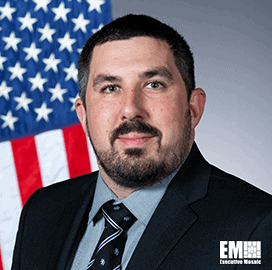
Dr. Robert Antypas
Space Access, Mobility and Logistics Mission Lead, AFRL
Robert Antypas coordinates AFRL’s customer engagement strategy and ensures synchronization with the technology needs of the USSF, Space Operations Command and Space System Command. He previously served as the interim electronic propulsion group lead in the In-Space Propulsion Branch.
Dr. GP Sandhoo
Director, Space Development Agency
Dr. GP Sandhoo leads the strategic direction and program execution for acquisition, delivery and operation of the Proliferated Warfighter Space Architecture, or PWSA. He’s also the USSF Portfolio Acquisition Executive for Missile Warning and Tracking. Sandhoo previously served as acting director and deputy director of SDA, where he delivered essential space-based capabilities to the joint warfighter in support of terrestrial missions.
Jacob Glassman
Deputy Assistant Secretary for Science and Technology, Department of War
Jacob Glassman is responsible for overseeing all foundational initiatives within the DOW’s S&T enterprise. He directs the defense research laboratories, and the warfighting and engineering centers, the Pentagon’s federally-funded R&D centers and university-affiliated research centers, and the department’s basic research investments. He previously served as the Navy’s senior technical advisor to the assistant secretary of the Navy for research, development and acquisition.

Chris Jones
Chief Technology Officer, Nightwing
Chris Jones is a seasoned intelligence community executive leader with more than 28 years of experience. Before joining Nightwing, he spent most of his career with the CIA in executive leadership roles, most recently serving as associate deputy director for science and technology with responsibility for several thousand employees.
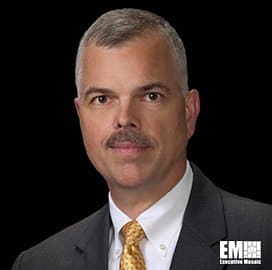
Ron Fritzemeier (moderator)
Director of Mission Solutions, Intel Government Technologies
Ron Fritzemeier is a retired rear admiral who joined Intel Government Technologies in 2022. He advises Pentagon and intelligence community leaders on options to achieve mission success through modernization and enhanced processing and employment of data as a strategic asset. Fritzemeier served as U.S. Strategic Command’s Nuclear Command, Control and Communications Enterprise Center director before retiring from the Navy in 2021.