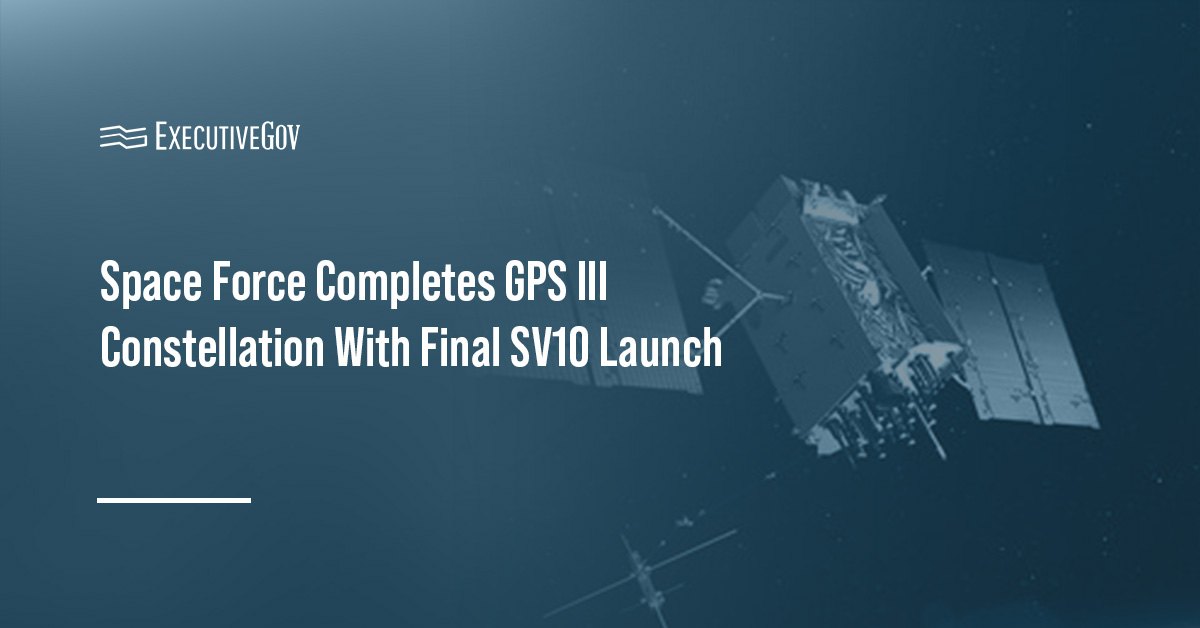
A SpaceX Falcon 9 rocket deployed the final Lockheed Martin-built GPS III satellite on Tuesday from Cape Canaveral Space Force Station in Florida for the U.S. Space Force.

Top leaders from the U.S. Space and Air Forces will examine how advanced technologies and strategies are shaping responses to evolving air and space challenges at the Potomac Officers Club's 2026 Air and Space Summit on July 30. Register now!
Space Systems Command announced the milestone on the same day, noting that Space Vehicle-10 brings the operational GPS constellation to 32 satellites. SSC claimed that SV-10 completed the Space Force's most resilient GPS architecture to date, advancing positioning, navigation and timing capabilities for military and civilian users.
The launch demonstrated the National Security Space Launch program’s ability to adjust schedules quickly, with the Space Force executing a provider change and revised launch timeline in under seven weeks. USSF Col. Ryan Hiserote, SSC System Delta 80 commander, NSSL program manager and GPS III-8 mission director described the move as a “remarkable achievement compared to traditional timelines.”
What Capabilities Does the Final GPS III Satellite Add?
SV-10 reportedly provides three times greater accuracy and improved resistance to jamming compared to earlier systems. It features secure M-code capability designed for military users operating in contested environments and carries several demonstration technologies, including an optical crosslink payload that enables satellites to communicate directly in orbit, a new atomic clock for improved timing precision, a laser retroreflector array supporting scientific measurement and system performance, and a 3D-printed antenna component intended to reduce production time and cost.
How Do the Payloads Support Future GPS Modernization?
The demonstration technologies will inform the development of the next-generation GPS IIIF satellites, which are expected to further strengthen anti-jamming capabilities and introduce new features, such as Regional Military Protection to improve signal availability for military users in high-threat environments, a search-and-rescue payload and fully digital navigation technology.
Lockheed said the IIIF variant is being manufactured at its Denver, Colorado, facility. The company, under contract to deliver 12 IIIF units, is using augmented reality, digital twins and other emerging technologies to accelerate production timelines.