- Maj. Gen. Christopher Povak has detailed NRO’s push for joint integration
- NRO prioritizes constellation proliferation, cloud computing, data fusion
- NRO’s Ryan Lewis will keynote the 2026 Intel Summit on Sept. 24
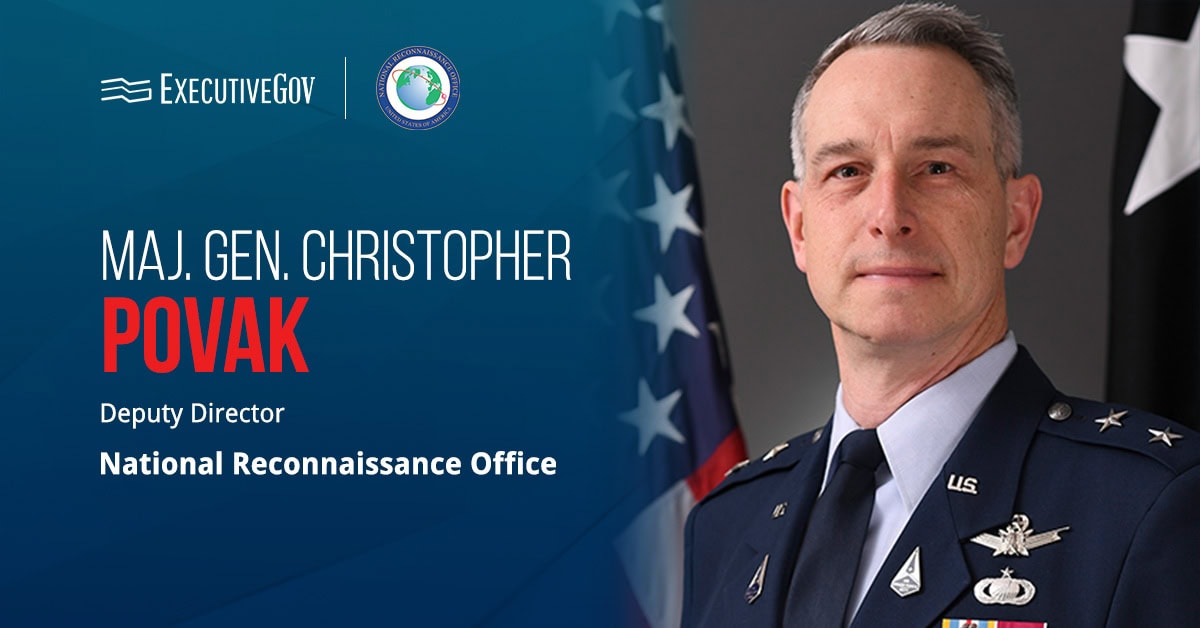
Maj. Gen. Christopher Povak, deputy director of the National Reconnaissance Office, said NRO is working to synchronize and integrate its architectures with the U.S. Space Force, other Department of War components and the intelligence community to maintain a stronger understanding of threats in the space domain than competitors.
“We have to have a better insight than any competitor in the world on what is happening in the space domain, what is a threat, and what we are going to do about it,” Povak said. “From foundation through the delivery of a capability, we’re ensuring the synchronization and the integration of architectures with Space Force and the rest of the DoW and IC.”

As the intelligence community works to pair automation and artificial intelligence with space-based capabilities, government and industry stakeholders continue to examine how these technologies reshape mission execution. The Potomac Officers Club’s 2026 Intel Summit on Sept. 24 will explore these priorities. Ryan Lewis, SIGINT Directorate chief architect at NRO, will deliver the event’s keynote address, with panels covering agentic AI and quantum risk, open source intelligence, and cybersecurity in the agentic AI era. Save your spot now to join the conversation.
What Is NRO’s Approach to Next-Generation Sensors & Testing?
At a conference on Tuesday, Povak said NRO’s ability to deliver agile, responsive capabilities comes from decades of collaboration with end users and that the agency continues to concentrate on the areas where it holds a leading position across the federal government.
“We are continuing to focus on the areas where the NRO is the leader in the United States government,” he said. “What is the next generation of GEOINT and signals intelligence sensors that we need to continue our competitive advantage? How are we injecting automation and artificial intelligence into our workflows to make our systems more responsive, more rapidly deployable, and relevant to our community?”
NRO pairs its research and development pipeline with rigorous operational testing, incorporating new architectures into real-world training scenarios so that emerging technologies can be adopted by warfighters and analysts alike.
“We must continue to get reps and sets on these architectures through joint exercises in partnership with the Air Force, Space Force, and others,” Povak said.
What Is NRO Prioritizing to Accelerate Data Fusion?
NRO is directing resources toward constellation proliferation, cloud computing system resilience and digital workflows to shorten the timeline between sensor data collection and decision-making. As its satellite architecture expands, fusing data sets at scale has become a growing priority, one that grows more complex as the space domain evolves.
How Does the Push for Integration Align With NRO’s Modernization Agenda?
The integration push comes amid several other changes underway at the agency.
Roger Mason, then nominee for the NRO director post, told senators that commercial space capabilities and AI were reshaping the agency, and stressed the need for stronger industry relationships and clearer long-term requirements. Mason was sworn in as NRO’s 20th director on Aug. 17.
NRO and the National Security Agency are also restructuring their SIGINT collection and processing to fuse data across domains, and the wider intelligence community is retooling to embrace AI at scale.
At the Potomac Officers Club’s 2025 Air and Space Summit, Povak described a more aggressive acquisition strategy built around proliferated, resilient systems rather than single points of failure. On orbit, the NROL-172 launch extended the constellation’s support for ground moving target indication, and the NROL-105 mission added to the agency’s growing satellite fleet.