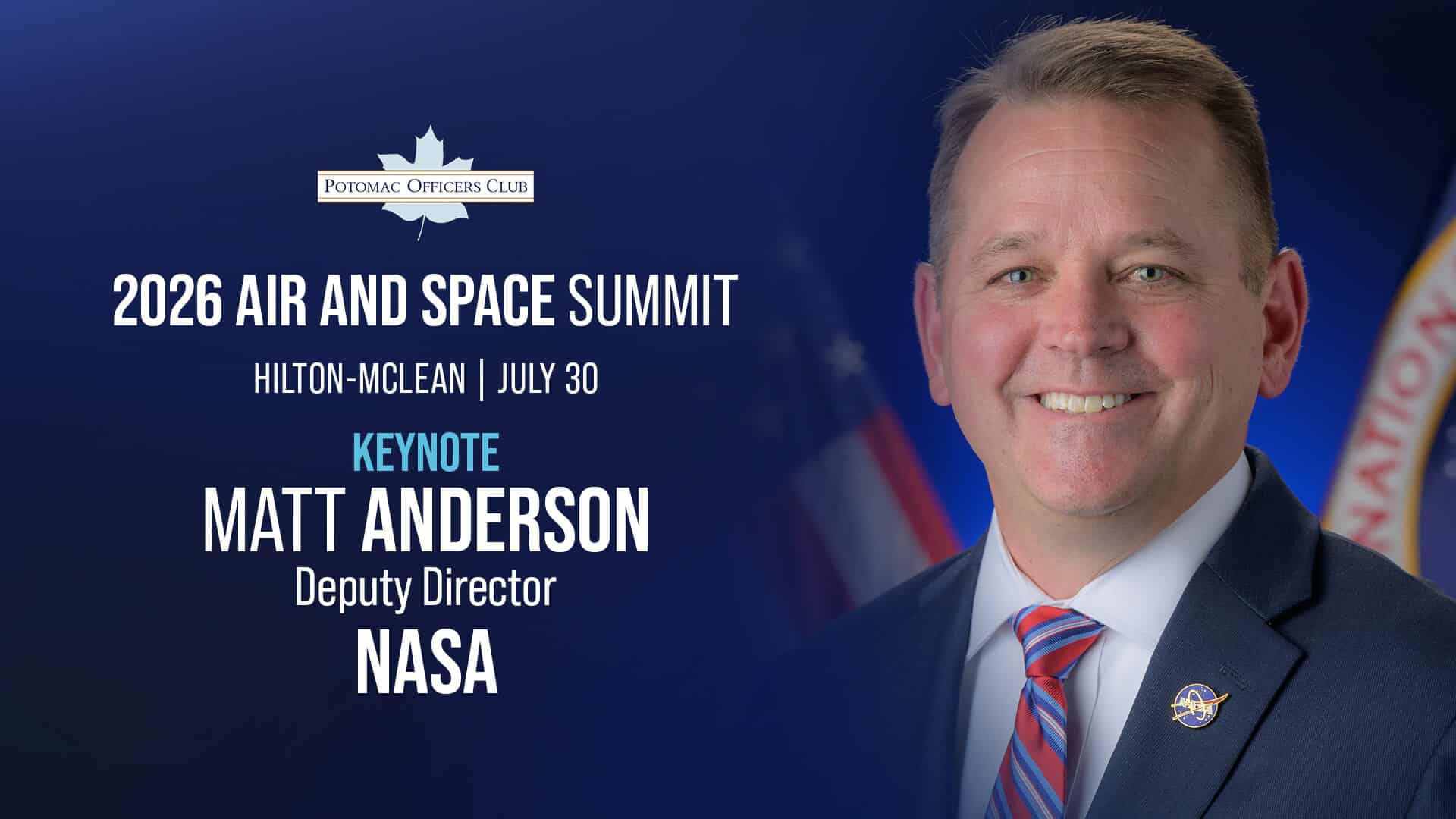
- Retired Air Force Col. Matt Anderson, NASA’s deputy administrator, will deliver a keynote on the role of space in national security and warfighting, the new space race, and public-private collaboration to drive innovation
- As NASA’s second-highest-ranking official, Anderson helps oversee the agency’s science and space programs, including Artemis
- Leaders from NASA, the Space Force, the Air Force and industry will share insights on national space priorities at the 2026 Air and Space Summit
Potomac Officers Club, the nation’s leading GovCon networking and events organization, is honored to announce that retired Col. Matt Anderson, the 16th deputy administrator of NASA, will deliver a keynote address at the 2026 Air and Space Summit on July 30. A decorated Air Force command pilot and a former defense industry executive, Anderson offers a unique perspective on the role the space domain plays in modern warfighting and how the private sector can support U.S. efforts to maintain strategic advantages in a competitive space environment.

Anderson’s keynote comes at a time when the U.S. government is strengthening its in-orbit capabilities to support military readiness and effectiveness and to expand its presence beyond Earth’s orbit. His insights and perspective on national security, innovation, space operations and public-private collaboration are expected to resonate with defense and aerospace leaders alike. Register today to hear from Anderson and other top leaders shaping the future of space operations.
Who Is Matt Anderson?
Responsibilities at NASA
As deputy administrator, Anderson oversees agency operations and spearheads strategic initiatives that advance national space priorities.
Anderson was first nominated as for the role in May 2025. After the Senate failed to consider the original nomination before the end of last year, he was renominated in January, SpaceNews reported. The Senate confirmed Anderson as NASA’s second in command in May.
He works alongside NASA Administrator Jared Isaacman, a 2026 Wash100 Award winner, in managing the agency’s science, aeronautics and space programs.
“Matt Anderson brings exactly the kind of operational leadership, technical expertise, and mission focus NASA needs right now,” Isaacman said during Anderson’s swearing-in ceremony in May. “His decades of experience across the Air Force, Space Command and the aerospace industry give him a valuable perspective as we work to strengthen America’s leadership in space and enter the next era of exploration. I’m excited to have him helping lead NASA as we take on the near-impossible and push the boundaries of what we can achieve.”
Air Force & Private Sector Career
According to his biography on NASA.gov, Anderson grew up on U.S. Air Force bases where his father served as a chaplain.
He attended the U.S. Air Force Academy, earning a bachelor’s degree in biology, and later received a master’s degree in aeronautical science from Embry-Riddle Aeronautical University.
As an Air Force pilot, he has accumulated more than 5,000 flight hours across multiple aircraft, including over 600 in combat operations.
During his more than two decades in the Air Force, he held several leadership positions, including commander of the 4th Airlift Squadron, senior aide-de-camp to the commander of the North American Aerospace Defense Command, and senior liaison officer to U.S. Space Command, U.S. Northern Command and NORAD.
He retired from military service in 2021. Since then, he has held leadership roles in the space industry. From February 2021 through May 2026, he served as the vice president and Space Force and Air Force client executive at CACI International. He was also the chief growth officer for the Space Force Association for nearly three years.
Find out how Anderson’s experience in the military and industry has influenced his work at NASA at the 2026 Air and Space Summit on July 30. Tickets are now available here.
Matt Anderson on China and the Race to the Moon
At his Senate confirmation hearing, Anderson said ensuring the U.S. returns to the moon before China is one of his top priorities for NASA, Space Daily reported. His priorities align with President Donald Trump’s December 2025 executive order, Ensuring American Space Superiority, which calls for America’s return to the moon by 2028.
China and the U.S. are in a race to land humans on the moon before the end of the decade. NASA has already made progress with Artemis II’s flyby mission in April, and the agency plans to launch Artemis III to carry out rendezvous and docking demonstrations by late 2027, Space.com reported.
NASA is working with SpaceX and Blue Origin to develop the landers that would deliver astronauts to the lunar surface. Isaacman assured lawmakers during an April House Appropriations Committee hearing that he has spoken about meeting the agency’s “needs for a late 2027 rendezvous, docking and test” and landing attempt by 2028.
Meanwhile, China continues to advance its lunar exploration program. According to Aerospace America, Beijing conducted a Long March 10 rocket static fire test in September. China Manned Space Agency also said testing of its lander, spacesuit and moon buggy is underway.
What Will Matt Anderson Discuss at the 2026 Air and Space Summit?
As NASA deputy administrator and a former Air Force leader with ties to the defense and aerospace sectors, Anderson offers a unique perspective on the growing importance of space as a strategic domain and the role government and industry play in advancing U.S. leadership beyond Earth.
Drawing from his experience at NASA, the U.S. Air Force and the private sector, Anderson will likely discuss:
- NASA’s role in advancing U.S. space priorities
- The Artemis program and the next phase of lunar exploration
- America’s efforts to maintain leadership in space amid increasing competition from China and other global powers
- Emerging technologies shaping the future of space operations, including autonomous systems, robotics and advanced communications
- How civil, military and commercial space organizations can work together to strengthen national security, accelerate innovation and support future space initiatives
Who Else Will Be Speaking at the 2026 Air and Space Summit?
The Potomac Officers Club’s 2026 Air and Space Summit will convene leaders from the public and private sectors to discuss the U.S. government’s increasing prioritization of space to strengthen national security and ensure the domain remains free for exploration and use.
Gen. John Lamontagne, vice chief of staff of the Department of the Air Force, and Tom Ainsworth, acting assistant secretary of the Air Force for space acquisition and integration and Space Service Acquisition Executive (pending confirmation), are also set to deliver keynotes at the summit.
Other space leaders who will join the event include:
- Col. Ryan Frazier, acting portfolio acquisition executive for space-based sensing and targeting, Space Force
- Dr. Kelly Hammett, director and program executive officer, Space Rapid Capabilities Office, Space Force
- Greg Heckler, deputy program manager for capability development, space communications and navigation program, NASA
- Dr. GP Sandhoo, director, Space Development Agency
- Col. Aaron Stevenson, deputy director, Commercial Space Office, Space Systems Command
- Col. Jason West, commander, System Delta 85, Space Force
More speakers from NASA, the Space Force, the Air Force and industry will be added in the coming weeks!
Why Should GovCons Attend the 2026 Air and Space Summit?
At the 2026 Air and Space Summit, attendees will:
- Join panel discussions exploring the critical priorities and challenges confronting the Air and Space Forces, such as space communications, artificial intelligence and machine learning in warfighting, and network resilience and modernization.
- Hear from top executives at leading government contracting and technology firms, including SAIC, Ultra I&C and Amazon Web Services.
- Understand how government and industry are collaborating to advance defense innovation and accelerate capability delivery to warfighters.
- Connect with decision-makers, military leaders and industry innovators through dedicated networking opportunities throughout the event.
Sign up today to join the conversation about the future of the air and space domain.