- NIST has renamed the AI Safety Institute Consortium as the NIST Artificial Intelligence Consortium
- The consortium will focus on AI measurement, adoption and innovation
- The 2026 FedCiv Summit on Oct. 29 will examine scaling AI across government agencies
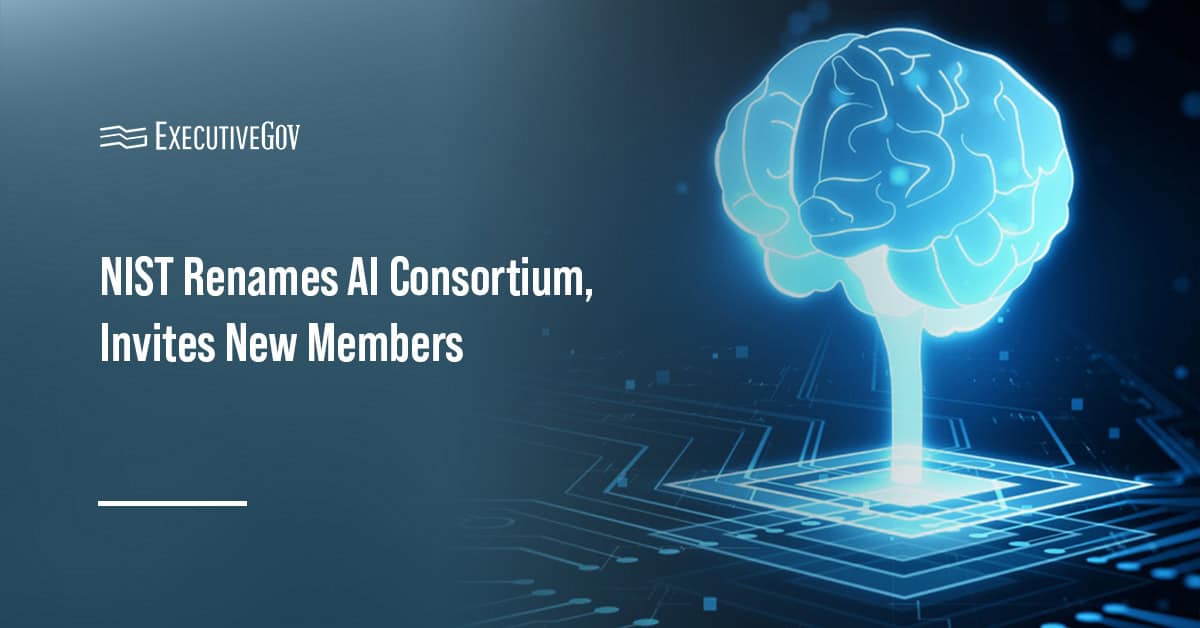
The National Institute of Standards and Technology has renamed the AI Safety Institute Consortium as the NIST Artificial Intelligence Consortium and opened membership to additional organizations with relevant technical capabilities.

As NIST expands the scope of its newly renamed AI Consortium, government and industry leaders continue to explore how AI can be deployed at scale across federal agencies. These issues will be among the topics discussed at the Potomac Officers Club’s 2026 FedCiv Summit on Oct. 29, where experts will examine strategies for powering and scaling AI across the government. Sign up now!
NIST said Friday the renamed consortium will continue some of its existing work while expanding its focus to AI measurement, adoption and innovation.
“We are inviting technically capable organizations to join the NIST AI Consortium to address the challenges associated with the development and deployment of AI,” Craig Burkhardt said in a statement published Friday.
“To encourage more extraordinary AI technological innovations, NIST is seeking to expand its AI measurement efforts by harnessing the broader community’s interests and capabilities,” he added.
In 2023, NIST established the AI Safety Institute Consortium and brought together more than 280 organizations to develop science-based guidelines and standards for AI measurement.
What Is the Expanded Scope of the NIST AI Consortium?
According to NIST, the consortium will focus on creating an AI evaluation ecosystem, fostering the use of U.S.-developed AI technologies and systems, and investing in AI-enabled science. It will also support the development of measurement science to identify scalable, interoperable techniques and metrics for AI development and deployment.
The agency said the expanded consortium supports the implementation of NIST’s Strategy for American Technology Leadership in the 21st Century, an AI executive order signed in January 2025 and the White House’s AI Action Plan.
What Are the 6 Task Groups of the Consortium?
The reorganized consortium will carry out its work through six task groups:
- AI Testing, Evaluation, Verification and Validation Zero Draft Task Group — will provide tools to help determine whether AI systems meet design requirements and are sufficient for intended uses. The group will also develop stakeholder-driven “zero drafts” of standards for submission to the private sector-led standardization process.
- Annotation for AI Risks & Validity Task Group — will support the development of a science-based toolkit for assessing AI risks and impacts through NIST’s ARIA program.
- AI Evaluation and Measurement Methods Task Group — will identify and prioritize gaps, barriers and open questions in AI evaluation science using input from organizations across sectors and stakeholder groups.
- Bias Effects and Notable Generative AI Limitations Group — will work with the Intelligence Advanced Research Projects Activity to explore solutions to misinformation, sensitive information leakage, flawed reasoning and AI system vulnerabilities. NIST said the effort is intended to support the use of large language models for intelligence analysis.
- AI Documentation Cards Task Group — will develop standardized templates for documenting AI datasets, AI models and systems, and AI testing, evaluation, verification and validation activities.
- Chemical and Biological Security Task Group — will share insights on emerging AI measurement and evaluation approaches related to chemical and biological security.
How Can Organizations Join the NIST AI Consortium?
Organizations with relevant technical expertise may apply to join the consortium, with NIST planning to select participants on a first-come, first-served basis.
According to a Federal Register notice published Friday, each letter of interest should include the organization’s address, point of contact and information about the role or roles it could play in consortium activities. Applicants should also describe the expertise they would contribute and identify the products, services, data or other technical capabilities they would use in or contribute to consortium work.
NIST noted that existing members can continue their participation by agreeing to the consortium’s updated structure. New and continuing members will work with the agency under a cooperative research and development agreement.